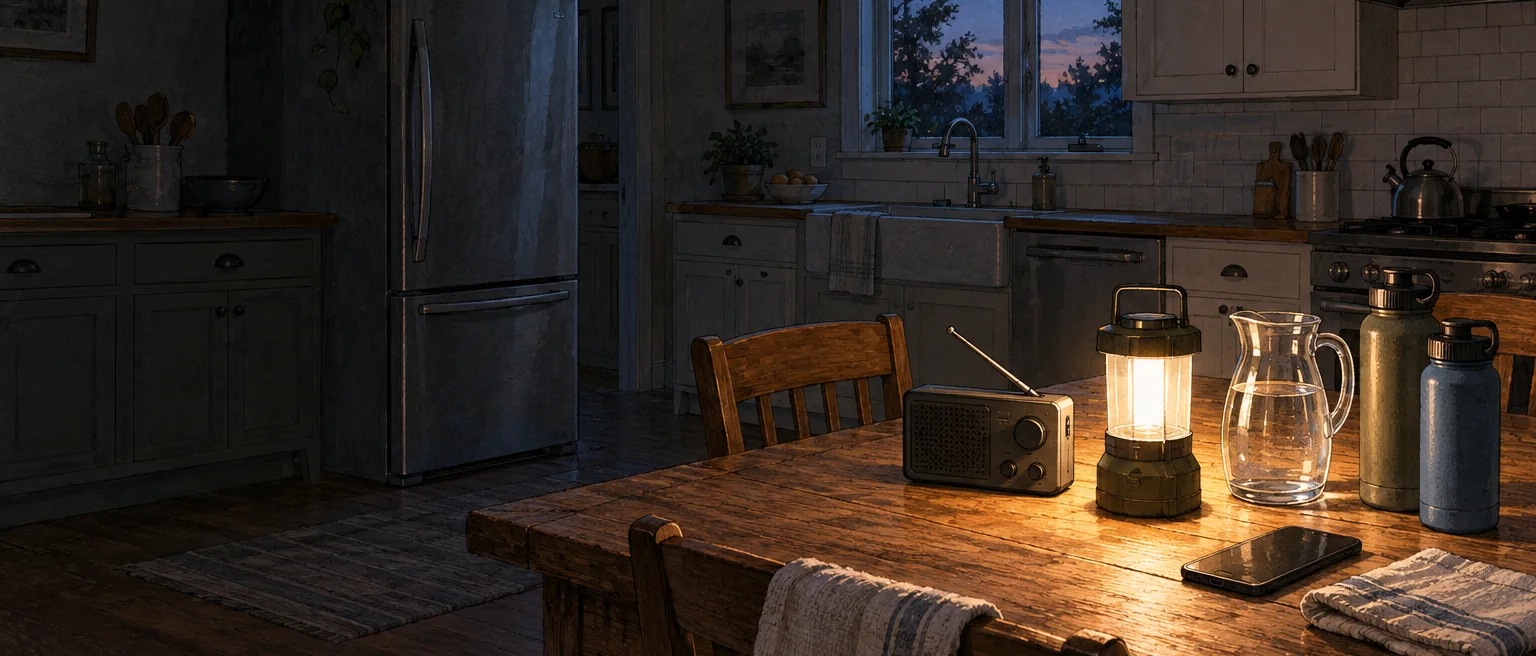
When you have done nothing to prepare
Grid Down
The power is out and it is not coming back in hours. No generator, no solar panels, no plan. Every system in your house that uses electricity just stopped working, and that is more systems than most people realize.
Puerto Rico waited 11 months. Parts of Texas went days in sub-freezing cold. When the grid fails for longer than a day, the problem is not the darkness. It is everything the darkness takes with it: water pressure, refrigeration, heat, medical devices, phones, fuel pumps, and the ability to pay for anything.
By Dan Whelan, founder of New World Survival
Researched from government agencies, university extension services, and other published sources. See our sources
FROM THE FIELD
The darkness is harder than the hunger. That pattern holds across every extended outage on record, from Puerto Rico to Texas to the Northeast. Survivors consistently describe the same thing: it is not the first day without power that breaks a household, it is the loss of routine, the unrelenting dark, and the absence of any timeline for restoration. This guide covers the mechanics of staying fed, warm, and safe. The field says to also protect your household's rhythm, because that is what actually erodes first.
Before you read further
What this guide assumes
This plan assumes the power is out across your area, not just your house. Utility crews are working but restoration could take days, weeks, or longer. Water may lose pressure. Cell service may degrade. Stores may close or limit purchases. Gas stations cannot pump.
It also assumes you have no generator, no solar, no stored water, and no plan. You are working with whatever is already in the house. That is where most households are when the lights go out, and it is a workable starting point if you act on the right things in the right order.
This guide is not medical advice. If someone in your household depends on a powered medical device, call your utility company and your medical provider immediately. Most utilities maintain a medical-priority registry for restoration.
Understand this first
The cascade: what fails and when
A grid failure is not one problem. It is a chain of systems losing their energy source, and each failure makes the next one harder to solve. Knowing the order lets you prioritize before the chain gets ahead of you.
From the field · In Texas during Winter Storm Uri, the water cascade did more household damage than the power loss itself. Pipes froze, water heaters burst, and plumbers were booked for weeks. The families that drained pipes and shut off the main valve early avoided bills that exceeded the outage cost.
Lights, electronics, appliances
Immediate. Everything plugged in stops.
Refrigeration and frozen food
The clock starts immediately but the food is safe for hours if you keep the doors closed. According to the FDA: 4 hours for a closed fridge, 48 hours for a full freezer, 24 if half full.
Water pressure
Municipal water systems rely on electric pumps to maintain pressure. Some have backup generators; many do not. When pressure drops, taps slow to a trickle and eventually stop. If pressure drops below safe levels, the system can become contaminated. Boil-water advisories are common after extended outages.
Cell towers and internet
Most cell towers have battery backups that last roughly 4 to 8 hours. After that, towers go dark in order of distance from fuel and repair crews. Your phone may still have battery, but there may be nothing to connect to. Home internet (routers, modems) dies with the power.
Payments, ATMs, and fuel pumps
Card readers, ATMs, and gas station pumps all run on electricity. When they stop, the only currency is cash and the only fuel is what is already in tanks. This is the same failure that hits during a financial collapse, but the cause is different.
Heating or cooling
Even gas furnaces need electricity for ignition, fans, and thermostats. Air conditioning stops entirely. In extreme cold or heat, a house without climate control becomes dangerous within hours. According to the CDC, extreme heat and extreme cold are each responsible for hundreds of deaths per year in the United States.
Medical devices
CPAP machines, oxygen concentrators, powered wheelchairs, home dialysis, refrigerated medications (including insulin). Battery runtimes vary from hours to a day. When they run out, the person needs a facility with power. This is the most urgent item on the cascade for households that depend on one.
Sanitation
Toilets flush with gravity until the tank is empty. After that, they need water poured in manually. Wastewater treatment plants lose pumping capacity. In extended outages, sewer backups and contaminated water become real risks.
The first day
First 24 hours: secure what the cascade is about to take
Water first
Fill every clean container while the taps still work: pots, pitchers, bottles, the bathtub. If water pressure has already dropped, you are working with whatever you have stored plus what you can safely collect. The EPA recommends one gallon per person per day for drinking and basic sanitation. A family of four needs about four gallons a day at minimum.
Medical devices and medications
If anyone in the household uses a powered medical device, check its battery status now. Call your utility to register on the medical-priority list. Call your medical provider for contingency instructions. Locate the nearest hospital or shelter with power. Move refrigerated medications (including insulin) to a cooler with ice if available.
Do not open the fridge or freezer
Every time you open the door, you lose cold. A closed fridge is safe for about 4 hours; a full freezer for about 48. Make a plan for what you will eat and in what order: refrigerated food first, frozen food as it thaws, then shelf-stable last. This is your food timeline and it starts now.
Conserve phone battery
Turn off Wi-Fi, Bluetooth, and location services. Lower screen brightness. Switch to airplane mode and check for signal periodically rather than letting the phone search constantly. Use texts instead of calls (they use less power and go through on weaker signals). Charge power banks and laptops from your car if needed, but do not idle the car in a garage.
Get cash and fuel while you can
If any ATMs or gas stations still have power, get cash in small bills and fill the tank. Both may stop working within hours. Cash is the only payment method when card networks are down.
Find a battery-powered or hand-crank radio
AM/FM radio is the most resilient broadcast system. It works when cell towers, internet, and TV are all down. Local stations carry emergency information, restoration estimates, shelter locations, and water distribution points. If you do not own one, a car radio works.
Talk to your neighbors
Find out who has information, who has medical needs, who has small children, who is alone. A grid failure turns your street into your support system whether you planned it that way or not. Two or three households sharing information and watching out for each other changes everything.
Generator safety
If you have or borrow a portable generator: never run it indoors, in a garage, on a porch, or near any window, door, or vent. The U.S. Consumer Product Safety Commission reports that portable generators cause an average of nearly 100 carbon monoxide deaths per year. CO is odorless and invisible. Place generators outdoors, at least 20 feet from any opening, with the exhaust pointed away from the house. More people have died from generator CO poisoning after storms than from the storms themselves.
Days 2 through 7
First week: manage what you have, find what you need
From the field · The most common regret in after-action accounts: throwing away spoiled food and damaged property without photographing it first. Insurance claims require evidence. A few minutes with a phone camera before you clean up can be worth hundreds of dollars later.
Manage your food timeline
Fridge food should be eaten or cooked by day two. Freezer food is next as it thaws. Cook it all before it spoils and eat it first. Then shift to shelf-stable food: canned goods, peanut butter, crackers, dried fruit, cereal, granola bars. One-pot meals on a grill, camp stove, or fireplace stretch further. Cook outdoors or with ventilation. Never use a charcoal grill or camp stove indoors.
Solve the water problem
If taps have stopped, you need a source and a way to make it safe. The hot water heater holds 30 to 80 gallons of drinkable water (turn off the power to it first, open the drain valve at the bottom). Toilet tanks (not bowls) hold clean water. If a boil-water advisory has been issued, bring water to a rolling boil for one full minute (three minutes at elevations above 6,500 feet), per CDC and EPA guidance. Listen to radio for water distribution points.
Handle temperature
In cold weather: Close off rooms you do not need and move everyone into the smallest comfortable space. Hang blankets over windows. Wear layers. A tent set up indoors traps body heat. Use a fireplace if you have one. Never use a gas oven, charcoal grill, or unvented propane heater for indoor heating.
In hot weather: Move to the lowest, most shaded floor. Hang wet sheets over windows. Drink water steadily, not just when thirsty. Go to a cooling shelter if one is open and you can get there. The CDC warns that heat-related illness can escalate quickly in older adults, young children, and people on certain medications.
Manage sanitation
Toilets work without power as long as you have water to pour into the tank or bowl. Use stored water, rainwater, or pool water (not drinking water) for flushing. If the sewer system fails, a bucket lined with a heavy trash bag and a small amount of cat litter or sawdust works as an emergency toilet. Wash hands with soap and any water. Hygiene prevents more emergencies than it costs.
Pool information, not rumors
Check the radio twice a day for restoration updates, shelter locations, and distribution points. Share confirmed information with your neighbors. Disregard secondhand claims about restoration timelines. Utility companies provide updates through radio and, where available, through their outage maps and phone lines.
When power comes back on
Power restoration can damage electronics. Before the grid returns, unplug sensitive devices and turn off breakers for major appliances. When power is confirmed stable, turn breakers back on one at a time. Plug electronics into surge protectors, not directly into wall outlets. Check your refrigerator and freezer temperatures before trusting that food is safe again.
Weeks 2 through 4
First month: the grid is not coming back soon
If you are still without power after a week, the outage is not routine. You are now managing a household without electricity for the foreseeable future. The shift is from waiting to adapting.
Establish a water routine
Whether it is a distribution point, a neighbor's well, rainwater collection, or a nearby stream, you need a reliable daily source and a way to treat it. Boiling is the most reliable method. If boiling is not possible, the EPA notes that plain unscented household chlorine bleach (labeled 6% or 8.25% sodium hypochlorite) can disinfect clear water: 8 drops of 6% bleach, or 6 drops of 8.25% bleach, per gallon. Double it if the water is cloudy, colored, or very cold. Stir, let it stand 30 minutes, and check for a slight chlorine smell; if there is none, repeat the dose once and wait another 15 minutes.
Build a cooking system
You need a way to boil water and cook food that does not depend on electricity. Outdoor grills (charcoal or propane), camp stoves, fire pits, and wood-burning fireplaces all work. Stock the fuel. Learn to cook one-pot meals from whatever you have: rice and canned goods, pasta and sauce, soups from scraps. Never use any combustion cooking device indoors without proper ventilation.
Manage the fuel you have
Gasoline in your car, propane in a grill tank, charcoal, firewood, batteries, candles. All of it is finite. Use it deliberately. Combine trips. Cook in batches. If you have a generator, run it for specific tasks (charging devices, running a freezer for an hour) rather than all day. A generator running 24 hours consumes far more fuel than most households can sustain for weeks.
Apply for whatever help exists
FEMA individual assistance, state emergency declarations, Red Cross shelters, community distribution points. Listen to radio for announcements. Drive to the nearest functioning town to apply if you need to. If the outage is widespread enough for a federal disaster declaration, FEMA assistance applications can be filed by phone at 1-800-621-3362 or at any Disaster Recovery Center.
Consider whether to stay
If the house is unsafe (no heat in winter, no cooling in extreme summer, mold from water damage, medical needs you cannot meet), leaving is not failure. Shelters, relatives in powered areas, or a motel in a town with electricity may be the right call. The households that did best in Puerto Rico's 11-month outage were the ones that made the stay-or-leave decision early rather than waiting until the situation became dangerous.
Months 2 through 6 and beyond
Long-duration: life without the grid
At this point you are not waiting for the grid. You are living without it. This is what Puerto Rico experienced for nearly a year, and what parts of Yemen and Ukraine have lived with for years. The household runs on what you can produce, find, trade, and share.
Your neighborhood is your grid now
The small circle you formed in week one is now critical infrastructure. Pooled resources go further: one household with a grill feeds several. Someone with a well shares water. Someone with medical training checks on older neighbors. In Puerto Rico, communities with strong neighborhood networks recovered measurably faster than those without.
Shift from stored food to produced food
Grow anything you can, even in containers. Fast greens, beans, whatever the season allows. Preserved and canned food stretches further when supplemented with fresh produce. If you have access to safe water and seeds, a small garden changes the math within a few months.
Solve lighting
Candles work but are a fire risk. Solar-powered garden lights (the kind you stick in a yard) can be brought indoors each evening. A headlamp with rechargeable batteries and a small solar charger provides reliable personal lighting. Flashlights drain batteries fast. Prioritize a sustainable light source over a bright one.
Skills and labor become currency
The same pattern that appears in financial collapse appears here: people who can do useful things trade their labor for what they need. Cooking, repairs, childcare, hauling water, cutting wood, organizing distribution. The grid may be down, but the community economy runs on competence and trust.
Watch for slow-moving health risks
Contaminated water, foodborne illness from improper storage, untreated infections, medication gaps, and heat- or cold-related illness are the leading threats in extended outages. In Puerto Rico, the excess death toll was estimated at nearly 3,000 people, the majority from disrupted medical care and unsafe conditions in the months after the storm, not from the storm itself. Hygiene, clean water, and checking on vulnerable neighbors are the best defenses.
Learn from the pattern
What usually does not work
Running a generator indoors, in a garage, or on a covered porch. This kills people every year.
From the field · Generator carbon monoxide deaths do not cluster on day one. Accounts from Texas and the Northeast show the same pattern: people who ran generators safely outdoors on day one moved them to garages or porches on day two or three, when cold or rain ground them down and fatigue replaced caution.
Opening the fridge and freezer repeatedly to "check on things." Every opening costs hours of safe food.
Assuming the power will be back "by tomorrow." Plan for a week, adjust if it comes back sooner.
Burning through all your fuel in the first two days running a generator around the clock.
Using a gas oven, charcoal grill, or unvented heater indoors for warmth. Carbon monoxide does not announce itself.
Waiting until the situation is dangerous before deciding to leave.
The pattern that holds
What actually carries people through
Most power outages end in hours or days. But when one does not, the households that come through it are not the ones with the biggest generators. They are the ones that understood the cascade, acted before each system failed, and leaned on their neighbors instead of isolating.
Water, food order, temperature management, and community. Those four things, managed deliberately, keep a household functional for weeks or months without electricity. Everything else is a convenience that makes it easier, not a requirement that makes it possible.
If this is still only a worry
Five things that change everything about a grid failure
A case of bottled water and a way to purify more (a pot to boil, or a few drops of unscented bleach).
A battery-powered or hand-crank AM/FM radio.
A flashlight, a headlamp, or a few solar garden lights you can bring inside.
Cash in small bills. Enough to buy groceries and fuel for a few days when cards do not work.
Knowing which neighbors you would check on and who would check on you.
That list costs less than a tank of gas. It is the difference between a bad week and a dangerous one.
This has happened before
Real grid failures, real households
The action plan above is drawn from what actually happened when the grid failed and stayed down. These four cases show different causes, but the household-level challenges are remarkably similar.
Puerto Rico, 2017-2018
Hurricane Maria
The entire island lost power. Restoration to all reconnectable customers took approximately 11 months, the longest blackout in U.S. history. The excess death toll was estimated at nearly 3,000 people, the majority from disrupted medical care and unsafe conditions in the months following the storm. Satellite analysis showed 80 percent of nighttime illumination disappeared immediately. Rural municipalities experienced outages exceeding 120 days at more than double the rate of urban areas.
Sources: GAO-20-141; U.S. Army Corps of Engineers; George Washington University Milken Institute School of Public Health
Texas, February 2021
Winter Storm Uri
The Texas power grid came within minutes of total, uncontrolled collapse. Over 4.5 million households lost power, many for days, in temperatures that dropped below zero in parts of the state. Pipes burst in millions of homes. Water systems lost pressure across dozens of cities. At least 246 people died. The grid was isolated from the national interconnection, which limited the ability to import power from neighboring states.
Sources: ERCOT post-event analysis; University of Houston Hobby School of Public Affairs; Federal Energy Regulatory Commission/NERC joint inquiry
Northeastern U.S. and Canada, August 2003
The Northeast Blackout
A cascading software failure shut off power to 55 million people across eight U.S. states and Ontario. Some areas were dark for two days. Water pressure dropped as pumping stations lost power. Traffic froze without signals. The event demonstrated how quickly a modern city stops functioning without electricity and how dependent normal commerce, transit, and communication are on a single energy source.
Sources: U.S.-Canada Power System Outage Task Force final report; FERC analysis
Ukraine, 2015-2016 and 2022-present
Targeted grid attacks
In December 2015 and 2016, state-sponsored cyberattacks shut down portions of Ukraine's power grid, the first confirmed cyberattacks to take down electrical infrastructure. From 2022 onward, sustained missile and drone strikes targeted energy systems. The IEA reported a 2.3-gigawatt shortfall against 12 GW of peak demand in summer 2024, with worst-affected regions receiving electricity only a few hours per day. Decentralized repair, emergency generation, and cross-border imports prevented total collapse.
Sources: IEA, "Ukraine's Energy Security"; U.S. Congressional Research Service R48067; Department of Homeland Security ICS-CERT
The pattern across all four: The grid failure itself was the trigger, but the real danger was the cascade it set off: water, then food, then communications, then medical access, then heat or cooling. The households and communities that managed those secondary failures deliberately, rather than waiting for the power to come back, had better outcomes by every measure.
If you have more time
Go deeper on what matters most
If this is still a worry rather than an event, the guides below cover each piece of the cascade in depth.
If the grid failure is part of a larger crisis, you may also want: Financial Collapse (if banks and payments are also failing).
Water
Storage, filtration, and clean water when the tap stops.
Energy
Generators, solar, batteries, and managing power.
Food Independence
Growing, preserving, and storing a real food supply.
Communications
Radios, family plans, and staying connected.
Medical Readiness
Medications, devices, and medical access planning.
Community
Neighbors, mutual aid, and the networks that matter.
Shelter and Home Security
Temperature management, weatherproofing, and keeping the house safe.
Utility Shutoff: What to Do
Protections, payment plans, and keeping the lights on.
Last reviewed: August 30, 2026. Safety claims in this guide cite FDA (food safety), EPA (water treatment), CDC (heat and cold illness), and the U.S. Consumer Product Safety Commission (generator carbon monoxide). This is not medical advice. If someone in your household depends on a powered medical device, contact your utility company and medical provider immediately.