When you have done nothing to prepare
War
The country is at war. You did not prepare for this. Most people do not. What follows is a guide for civilian households, not soldiers. It covers what changes, what to secure first, and how to keep a household running when supply chains break and the rules of daily life shift.
Sarajevo endured 1,425 days under siege. Ukrainian families have adapted to years of rolling blackouts and bombardment. British households ran on rationing for six years. The patterns are documented, and they are consistent: documents, supplies, trusted neighbors, and the willingness to adapt.
Before you read further
What this guide assumes
This guide is written for civilian households in a country at war, whether the fighting is nearby or far away. It covers both scenarios: the domestic home front where infrastructure still works but supply chains are strained, and the harder version where conflict reaches your area and you face the decision of whether to stay or leave.
It assumes you did nothing ahead of time. No emergency supplies, no evacuation plan, no document kit. That is where most families are when a conflict begins, and it is a workable starting point.
This guide is not legal, immigration, or military advice. Wartime regulations, travel restrictions, and legal obligations vary by country and change rapidly. Verify current rules through your national government and local authorities.
FROM THE FIELD
The families that scatter rarely reassemble the way they were. That pattern surfaces in account after account, from Sarajevo to Kharkiv to Aleppo. The dramatic moments of war get all the attention, but what civilians describe most is the slow dispersal: one child sent to relatives, a spouse conscripted, an elderly parent who refuses to leave. The household fragments before the fighting reaches the door. This page covers what to do with the household you have, wherever you are, starting with the documents that prove who you belong to.
Understand this first
What war changes for a civilian household
War is not one disruption. It changes the operating environment of daily life across every dimension at once. Some of these changes happen in days. Others take months. All of them have been documented in past conflicts.
Supply chains
Military logistics take priority. Fuel may be rationed or unavailable. Imported goods become scarce or expensive. Domestic production shifts toward military needs. Food, medicine, and fuel are typically the first shortages civilians notice.
Economy and money
Prices rise, especially for fuel, food, and imported goods. Currency may weaken. Savings lose value if inflation accelerates. Formal employment shifts. Wartime economies historically produce both scarcity and demand for specific labor.
Information
Official information becomes controlled. Misinformation increases from all sides. Social media becomes unreliable at the same time it becomes addictive. Knowing what is actually true requires more effort, not less, and the consequences of acting on bad information are higher.
Infrastructure
Power, water, communications, and transportation may be targeted, damaged, or degraded. Even where infrastructure survives, service may be intermittent or rationed. The grid-down cascade applies wherever power fails.
Movement
Travel restrictions appear quickly. Borders may close or slow to a crawl. Checkpoints, curfews, and restricted zones change what routes are available and when. Fuel scarcity limits how far you can go. The window to move is widest at the start and narrows fast.
Legal landscape
Emergency powers, martial law, conscription, price controls, requisitioning, and new regulations can change overnight. What was legal yesterday may not be today. What was available may be rationed. Stay current through official government channels.
The first day
First 48 hours: secure what matters most
Secure your documents
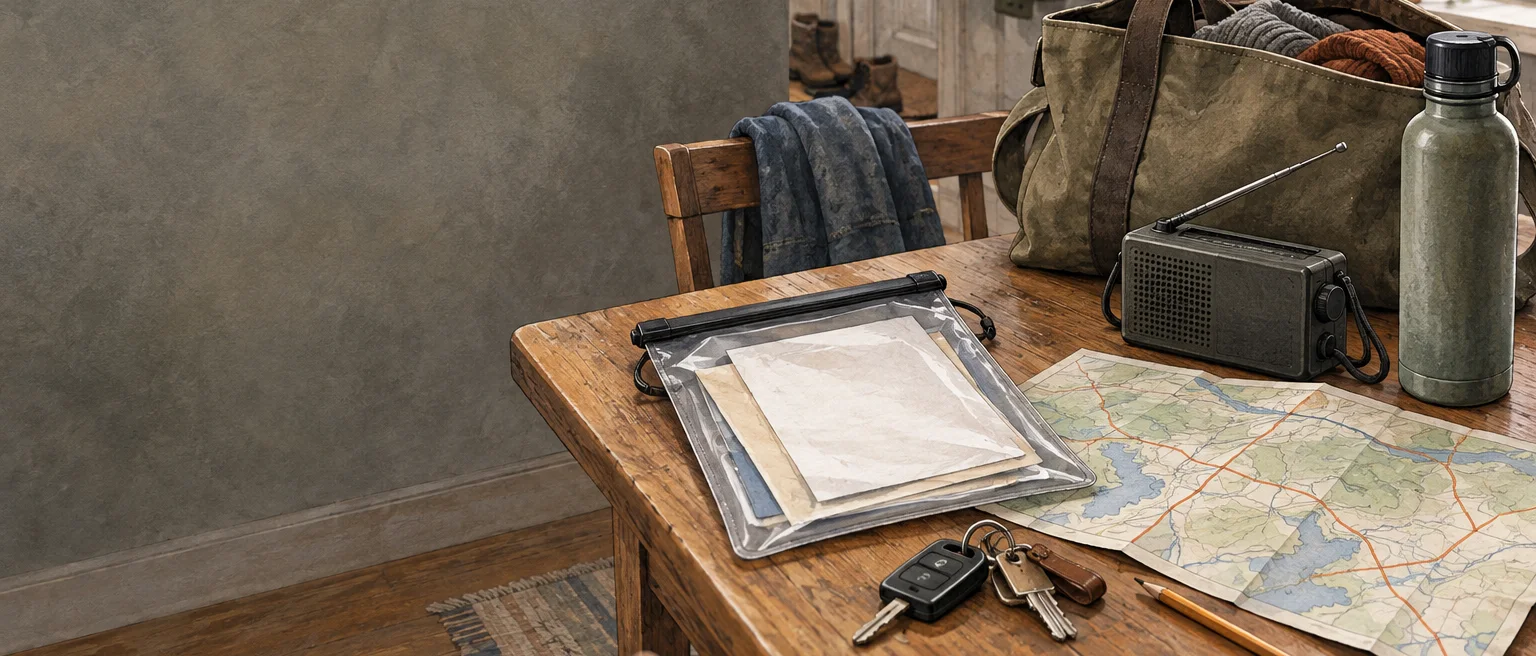
This is the single most important thing you can do in the first hours. Gather passports, birth certificates, Social Security cards, marriage certificates, insurance policies, medical records, property deeds, vehicle titles, and any immigration documents. Make copies. Store originals in a waterproof bag you can carry. Put copies in a separate location. Take photos of everything and store them in cloud storage and on a USB drive. Documents are what prove who you are, what you own, and what you are entitled to. In every conflict, the people who lost their documents had the hardest recovery.
Get cash and fill prescriptions
Withdraw cash in small bills from multiple sources. Fill every prescription you can. Buy a 30- to 90-day supply of any over-the-counter medications your household uses regularly. Cash, fuel, and medications are the three things that become scarce fastest in a conflict and the three things that are hardest to replace once they do.
Establish a communication plan
Decide on a meeting point if family members are separated. Choose an out-of-area contact everyone can check in with (a relative in another state or country). Write down phone numbers on paper. Agree on a simple code or check-in schedule. Cell networks and internet may become unreliable, overloaded, or monitored. A battery-powered AM/FM radio provides information when digital channels fail.
Stock essentials while stores are still functioning
Food (shelf-stable staples you already eat), water, batteries, candles or flashlights, a manual can opener, hygiene supplies, baby supplies if needed. Fill the gas tank and any legal extra containers. The same advice from the financial collapse and grid-down guides applies here: buy what you can carry, pay cash, and do not draw attention to yourself.
Get information from official sources
Government emergency broadcasts, embassy communications if you are abroad, official military communications. Limit social media consumption. In the first hours of every modern conflict, misinformation has spread faster than facts. Verify before acting. Verify before sharing. A rumor you repeat becomes a decision someone else makes badly.
The central decision
Stay or leave
This is the decision that defines everything else. It is not a one-time choice. It may need to be revisited as conditions change. But making it early, with clear criteria, is better than drifting into a situation where the choice is made for you.
Reasons to stay
Conflict is not near your area and infrastructure is still functioning
You have no specific destination with people who will take you in
Roads are already dangerous, congested, or closed
You have medical needs that require stable shelter and access to care
You have the supplies and community to sustain the household in place
Reasons to leave
Fighting is approaching your area or infrastructure is failing
You have a specific place to go and people expecting you
Routes are still open and you have fuel to reach your destination
Official authorities are advising evacuation
Someone in your household is in danger that staying cannot resolve
The lesson from every conflict: Leaving early with a plan is safer than leaving late under pressure. If you decide to go, go before the roads are clogged and the fuel is gone. If you decide to stay, commit to it and prepare the household for an extended period of self-sufficiency. The worst outcome is indecision: not leaving when you could have, then trying to leave when it has become dangerous.
Weeks and months
If you stay: adapting to wartime life
Learn what is rationed and how to get it
Formal rationing systems typically appear within weeks to months. In Britain during WWII, rationing covered food, clothing, fuel, and household goods for six years. Register for whatever system exists. Learn the rules. Supplement with growing, preserving, and trading. The informal economy fills gaps where the official one cannot reach.
Grow food
Britain's "Dig for Victory" allotments produced an estimated 10 percent of the nation's food during WWII. In besieged Sarajevo, residents grew vegetables in shell craters and public spaces. Any growing space helps. Containers, yards, community plots, rooftops. Start with fast-growing greens and calorie crops. A household that can produce even a fraction of its own food has more options than one that cannot.
Develop and trade skills
The same pattern from financial collapse and grid-down applies: people who can do useful things trade their labor for what they need. Wartime economies historically demand repairs, medical skills, childcare, food preparation, construction, and organization. Multiple small income or trade streams replace the single paycheck.
Manage information deliberately
Check official sources twice a day. Limit exposure to social media and rumor. Share only confirmed information. In every modern conflict, misinformation has caused real harm: panicked evacuations based on false reports, mobs acting on rumors, families separated by bad directions. The discipline of verifying before acting and verifying before sharing is a survival skill.
From the field · In every modern conflict, civilians describe the same exhaustion: not knowing which sources to trust. Official channels go silent or become propaganda. Social media fills the gap with a mix of real footage and fabrication. The households that stayed oriented were the ones that cross-checked before acting on any single report.
Maintain routines and protect morale
Children need school or structured learning even when schools close. Adults need daily rhythm even when employment disappears. Shared meals, simple entertainment, physical activity, and community projects reduce isolation and maintain psychological stability. This is not soft advice. In Sarajevo, residents organized orchestras, theatrical performances, and sports leagues during the siege. Structure protects sanity.
Your neighborhood is your resilience
In Ukraine, community networks have organized everything from air-raid shelter stocking to generator sharing to food distribution. In WWII Britain, air raid wardens, fire watchers, and neighborhood mutual-aid groups were civilian backbone. Know your neighbors. Pool resources. Watch out for the vulnerable. A connected block survives better than a collection of isolated households.
Six months and beyond
Longer term: when wartime becomes the new normal
Production replaces consumption
Extended conflicts force households from buying to making. Mending, cooking from whatever is available, preserving food, repairing instead of replacing, improvising tools and systems. "Use it up, wear it out, make it do, or do without" was the guiding principle of both the WWII home front and the Depression before it.
From the field · The accounts rarely describe the dramatic moments. They describe the weight of the ordinary: thinner meals, colder rooms, waiting for news that does not come, the strange guilt of laughing at something when the situation outside has not changed. The daily erosion, not the crisis, is what survivors say they were least prepared for.
Children and education
Education disruption is one of the most documented long-term consequences of conflict. According to research cited by the World Bank, children's interrupted education is among the lasting losses that extend well beyond the conflict itself. Maintain learning in whatever form is available: home instruction, neighborhood tutoring groups, community schools. The investment in children's continuity pays over decades.
Watch for recovery opportunities
Wars end, sometimes suddenly. Government programs, international aid, reconstruction employment, and new institutions often appear in the aftermath. In post-WWII Europe, the Marshall Plan rebuilt infrastructure. In Kosovo after 1999, international administration created new institutions and employment. In every case, the households that were still intact, still connected, and still had their documents were the ones positioned to participate in recovery.
Reassess continuously
Conditions change. What was safe becomes unsafe. What was unavailable becomes available. The stay-or-leave decision is not permanent. Keep documents accessible, keep the gas tank as full as possible, keep relationships warm in your destination area. The ability to move quickly if conditions deteriorate is a form of insurance that costs nothing to maintain.
Learn from the pattern
What usually does not work
Assuming the conflict will be short.
Waiting to see how things develop before securing documents, cash, and medications.
Acting on unverified information from social media.
Trying to evacuate after roads are clogged, fuel is gone, and borders are restricted.
Isolating from your neighbors. In every studied conflict, connected households outlasted isolated ones.
Hoarding visibly. A household that looks like it has more than its neighbors becomes a target, not a fortress.
The pattern that holds
What actually carries people through
In every studied conflict, the civilian households that came through were not the ones with the most supplies. They were the ones that secured their documents first, made the stay-or-leave decision early, maintained a small trusted circle, adapted their skills to the new economy, and managed information carefully.
Documents, decisions, community, skills, and discipline. Those five things, more than any stockpile, determined who recovered and who did not.
If this is still only a worry
Five things that change everything if conflict comes
All identity documents in one waterproof bag, with copies stored separately and photographed in cloud storage.
Cash in small bills. Enough for a tank of gas and a week of groceries.
A communication plan: where to meet, who to call, and numbers written on paper.
A two-week pantry and filled prescriptions.
A destination. Someone outside your area who would take you in, and a conversation about that before it is needed.
None of that requires spending more than a weekend. It is the difference between having options and having none.
This has happened before
Real conflicts, real civilian households
The advice above is drawn from documented civilian experiences during real wars. These four cases span different kinds of conflict, but the household-level patterns are consistent.
Ukraine, 2022-present
Civilian survival under active conflict
Millions of Ukrainian civilians adapted to life under bombardment: rolling blackouts, disrupted water and heating, supply chain breaks, and the constant calculus of whether to stay or leave. The World Bank estimated direct damage at $195.1 billion by end of 2025. Households that had even basic supplies, a communication plan, and documents ready to go had more options when the shelling started. Community networks organized generator sharing, shelter stocking, and food distribution.
Sources: World Bank RDNA5; IEA, "Ukraine's Energy Security"; U.S. Congressional Research Service R48067
Bosnia, 1992-1996
The Siege of Sarajevo
The longest siege of a capital city in modern warfare: 1,425 days. Residents survived without reliable electricity, water, food, or heating. They burned furniture and books for warmth, grew vegetables in shell craters, and traded whatever they had. The UN tunnel under the airport became a lifeline. Community and improvisation kept the city alive. Residents organized orchestras, theatrical performances, and sports leagues. The households embedded in strong neighborhood networks had better survival outcomes.
Sources: IMF conflict-and-recovery case studies; ICTY documentation; Bosnian War historical records
United Kingdom, 1939-1945
The home front
Rationing covered food, clothing, fuel, and household goods for six years. "Dig for Victory" allotments produced an estimated 10 percent of the nation's food. Children were evacuated from cities. Blackout rules were enforced nightly. Civilian volunteer networks (air raid wardens, fire watchers, Women's Voluntary Service) became essential infrastructure. Households adapted to scarcity as a permanent condition and rebuilt domestic skills that peacetime had made optional.
Sources: UK National Archives; Imperial War Museums; Ministry of Food historical records
Syria, 2011-present
Civilian displacement and survival
Over half the pre-war population was displaced. Those who stayed faced collapsed infrastructure, medicine shortages, and a destroyed economy. Informal networks, cross-border supply chains, and community kitchens kept people alive in areas where formal systems ceased to function. The IMF notes that by the end of a typical civil war, income is about 15 percent lower and absolute poverty about 30 percent higher than they otherwise would have been. Documents, cash reserves, and family networks determined who had options and who did not.
Sources: IMF, "The Macroeconomics of Conflicts and Recovery"; World Bank conflict studies; UNHCR displacement data
The pattern across all four: Documents first. Decide early whether to stay or go. Build a small circle of trusted people. Shift from consuming to producing. Maintain routines and protect children's continuity. Stay informed through official channels. The households that came through were not the wealthiest or the best armed. They were the most connected, the most adaptable, and the first to act.
If you have more time
Go deeper on what matters most
If this is still a worry rather than an event, the guides below cover each dimension in depth.
War often triggers the other crises on this site: Financial Collapse (wartime economies), Grid Down (infrastructure attacks).
Planning
Documents, budgets, and the household plan.
Food Independence
Growing, preserving, and storing a real food supply.
Communications
Radios, family plans, and staying connected.
Community
Neighbors, mutual aid, and the networks that matter.
Disruptions
Job loss, rent, medical crisis, shutoff notices.
Heritage Wisdom
Wartime and Depression-era knowledge that still works.
Displacement
When leaving becomes living somewhere else.
Water
Storing, treating, and finding clean water.
Energy
Power, heat, and light when the grid fails.
Digital Life
Account security, scams, and information hygiene.
Last reviewed: October 15, 2026. Case study data sourced from the World Bank, IMF, IEA, UK National Archives, and UNHCR. This is not legal, immigration, or military advice. Wartime regulations vary by country and change rapidly. Verify current rules through your national government and local authorities.