Household Management · Lesson 2 of 8
Who is responsible for what
You have the function map from lesson one. Now put names on it. This lesson covers the difference between doing a task and owning a responsibility, the owner-helper-backup model, and how to find the jobs that belong to nobody.
Build the matrixFROM THE FIELD
The fight is rarely about the dishes. It is about who had to notice them. Couples who have tried to rebalance household work describe the same arc. The chores get divided and the arguments continue. Things only change once one person takes over a whole job, the remembering included, instead of helping when asked. The owner, helper, and backup model below is built around that distinction.
The distinction
A task is not a responsibility
Take out the trash tonight: that is a task. It has a start, an end, and no memory. The trash never overflows, and it reaches the curb every collection day without anyone being asked: that is a responsibility. It has no end. It includes noticing the can is full, remembering which morning the truck comes, knowing the holiday schedule shifted pickup by a day, and doing something about all of it.
The distinction sounds small. It is the whole game. A household can divide its tasks evenly and still leave every responsibility on one person, because that person is still doing the noticing, the remembering, and the asking. From the outside, the labor looks shared. From the inside, one person is managing and everyone else is following instructions. That arrangement produces one of the most familiar household complaints: I should not have to ask.
The fix is not a better chore chart. It is moving ownership, not just labor. When someone owns a responsibility, the reminders stop being necessary, because the owner is the one who notices. This lesson is about assigning ownership honestly, with a backup behind every owner, so the household keeps running even when someone is out.
The difference between a task and a responsibility
A TASK
Take out the trash tonight.
One action with a clear start and end.
A RESPONSIBILITY
The trash never overflows.
Notice, remember, decide, and follow through without being prompted.
The model
Owner, helper, backup
Every recurring function on your map gets three assignments. The same person can hold different roles for different functions, and in a small household one person will hold several. The roles are what matter, not the headcount.
Owner, helper and backup roles
01 · OWNER
Holds the outcome
Notices the need, chooses the method, and answers for the result.
02 · HELPERS
Do pieces of the work
Contribute under the owner’s coordination without carrying the whole function.
03 · BACKUP
Can take over
Has enough knowledge to run the function when the owner cannot.
The owner
Holds the outcome. The owner notices when the function needs attention, decides how it gets handled, does or delegates the work, and answers for the result. Ownership includes the mental work: if you own feeding, you own noticing that the milk is low, not just cooking when asked. One owner per function. Shared ownership is how things fall through the middle.
The helpers
Do pieces of the work under the owner's coordination. A helper on laundry moves loads and folds. A helper on feeding chops vegetables or handles Tuesday dinners. Children make excellent helpers, and growing a helper into an owner of something age-appropriate, their own laundry, the pet's feeding schedule, is one of the most useful things a household can teach.
The backup
Can take over the entire function if the owner is sick, traveling, or stretched thin. That requires knowledge, not just willingness. The backup for money needs to know where the bills are paid from and when. The backup for health and care needs the pediatrician's name and the medication list. If the backup would have to be walked through everything, they are a helper wearing the wrong label.
Assign by capability and capacity, not by tradition or by who has always done it. The person who is home when the truck comes is the natural trash owner. The person who actually reads the insurance mail is the natural records owner. And check the totals. If one person owns six of eight functions, the map is telling you something, and lesson seven's conversation about sharing the load will be easier because the imbalance is now visible instead of felt.
The tool
Build the responsibility matrix
The responsibility matrix is one sheet of paper: your functions down the left side, and three columns for owner, helpers, and backup. It is the simplest management tool a household can adopt, and it borrows from the responsibility charts that businesses and emergency managers have used for decades, stripped down to what a family actually needs.
Example responsibility matrix
| Function | Owner | Helpers | Backup |
|---|---|---|---|
| Feeding | Mei | Theo, Emma | Wei |
| Records | Wei | — | Mei |
| Maintenance | Jun | Theo | Lian |
List the functions
Start from your lesson-one map. The eight functions are the rows. If a function is large in your household, split it: feeding might become weekday meals and weekend meals, or cooking and shopping. Keep the total under fifteen rows or the sheet stops being usable.
Fill in who does it now
First pass is descriptive, not aspirational. Write down who actually owns each function today, including the functions that are owned by default rather than by choice. Honesty here is what makes the next step meaningful.
Negotiate the second draft together
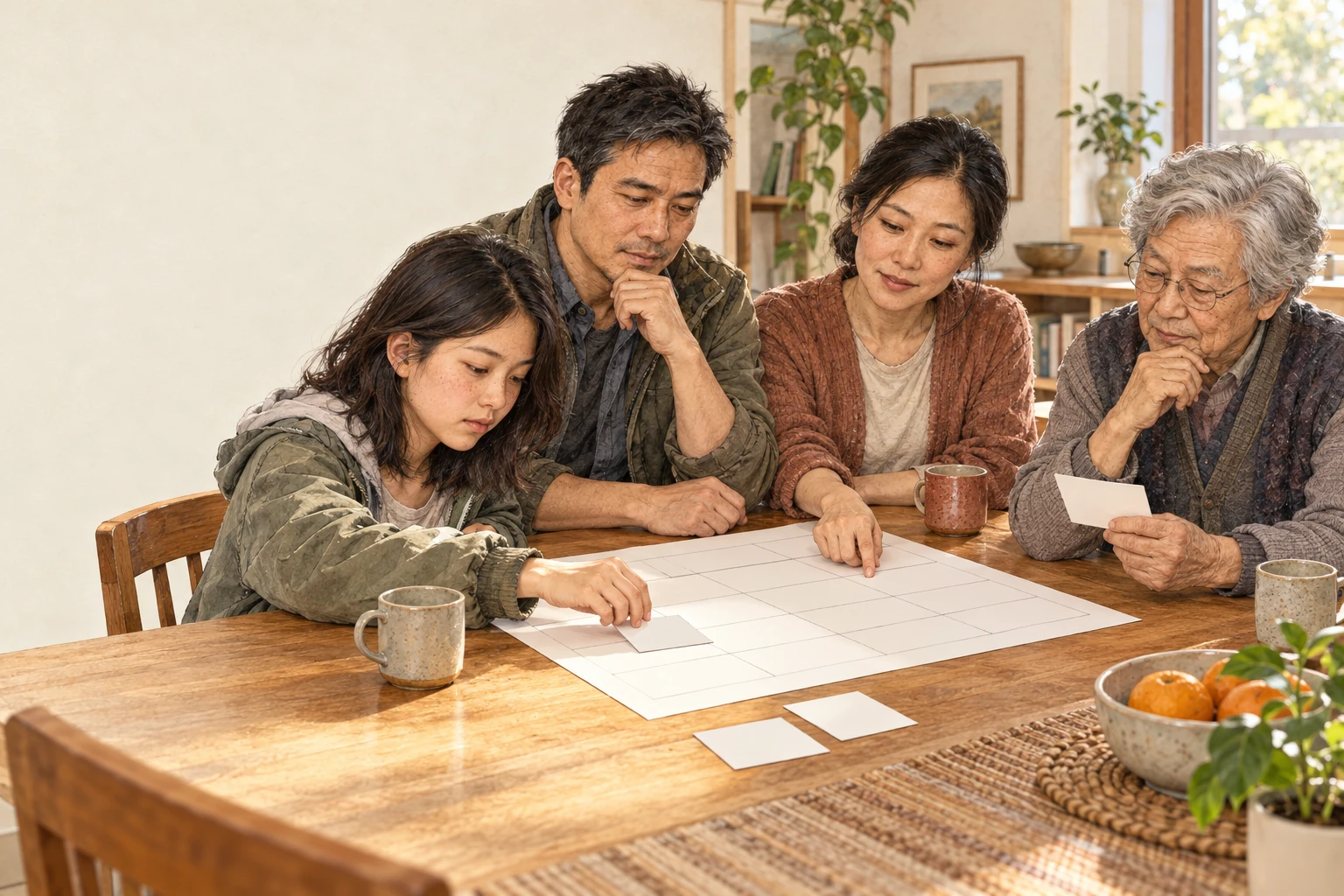
Sit down as a household and rebalance. Move ownership where capability and capacity actually live. Every function gets exactly one owner and at least one named backup. This is a 30-minute conversation for most households, and it goes better with the map on the table than it ever went as an argument in the kitchen. Agree on what done means for each function while you are at it: washed, or washed and folded; weekly, or when it looks bad. Ownership handoffs most often stall on a standard nobody said out loud.
Post it and date it
A matrix in a drawer is a matrix that does not exist. Post it where the household sees it: the fridge, the pantry door, the family command center. Date it, and plan to revisit it when circumstances change. A new job, a new school year, or a new family member all redraw the map.
From the field · Households that divide work with a chart or card system report the same slow failure. The first split goes well, nobody revisits it, and within months it describes a household that no longer exists.
A minimal version for a single-person household: you own everything, so the owner column is trivial, but the backup column is not. Your backup for critical functions is a person outside the household, the sibling who has a key, the friend who knows your vet, plus the written records that would let anyone step in. The Household Continuity track and the Documents and Records track carry that work forward.
The audit
Find the jobs nobody owns
With the matrix drafted, run the gap audit. Check every row against three questions. Each no is a gap, and gaps are where the next surprise is already forming.
Three-question gap audit
1 · OWNER
Who notices?
If nobody notices without prompting, the row has a gap.
2 · BACKUP
Who could take over?
If the answer is “they would figure it out,” the backup is not ready.
3 · SCHEDULE
When does it recur?
If it only happens when urgent, the rhythm is missing.
Does it have an owner?
Not a person who sometimes does it. A person who notices it without being reminded and answers for the outcome. Functions that only happen when they become urgent, the classic is home maintenance, are functions without an owner, whatever the matrix claims.
Does it have a real backup?
Could the named backup take over this week, with the knowledge they have right now? If the answer involves phrases like they would figure it out, the backup is aspirational. Fix it with a 20-minute walkthrough: here is how the bills get paid, here is the medication list, here is where the shutoffs are.
Does it have a schedule?
Owned work without a rhythm still runs on memory, and memory fails on busy weeks. The filter, the smoke alarm test, the oil change, the insurance review: recurring jobs need recurring slots. Lesson four builds the household rhythm that gives every owned function its place in the week, the month, and the season.
One caution as you audit. The goal is a household that runs, not a household that scores perfectly. If the gap list is long, pick the two or three gaps with the worst consequences, an unowned maintenance function, a money backup who knows nothing, and close those first. The rest can wait for the rhythm lesson. Ordinary friction about who does what is normal and worth working through together. This page is a planning tool, not a substitute for the harder conversations some households need, and it does not try to be one.
Next steps
Ready for lesson three?
Lesson 3
Needs, wants, and priorities
Take the matrix and decide what matters first. Needs and wants without the guilt, and a four-level ladder for ranking household work when there is more to do than time to do it.
Continue the trackThe full track
See all eight lessons
The Household Management track runs from lesson one through the written Household Operating Plan. See the full sequence and what each lesson covers.
Back to the trackContinue reading
What’s next
Planning
Household Continuity
The owner-helper-backup model from this lesson becomes critical when the owner is suddenly unavailable. Continuity planning extends the matrix to cover the hard weeks.
Learning Lab
Name and Divide the Work
A guided module for writing down who owns each recurring job in a shared home, including the noticing and scheduling nobody sees.
Household Management
The Household Operating Plan
Where the responsibility matrix ends up. The capstone pulls the map, the matrix, the rhythm, and the agreements onto one or two written pages.