Shelter · Pests & Wildlife
Deterrence & Lighting
Motion lights, sprinklers, fencing, and physical barriers that discourage wildlife from settling near your home. What works, what fades, and why layering matters more than any single device.
By Dan Whelan, founder of New World Survival
Researched from government agencies, university extension services, and other published sources. See our sources
Deterrence is the third layer of pest and wildlife prevention, after sealing the building and managing the habitat. It works by making the area around your home uncomfortable or unpredictable for animals, so they choose to go elsewhere before they ever reach an entry point.
The most important thing to understand about deterrents is habituation: the process by which animals learn that a stimulus poses no actual threat and stop responding to it. A motion-activated light startles a raccoon the first time. By the third or fourth encounter, the raccoon walks past it. USDA APHIS notes that visual deterrents generally have only short-term effectiveness, and animals often become accustomed to them.1
> This does not mean deterrents are useless. It means they work best when layered, rotated, and combined with the physical exclusion and habitat management that form the foundation of the approach. A motion light alone is insufficient. A motion light combined with a sealed building, managed yard, and periodically relocated sprinkler is a system. <
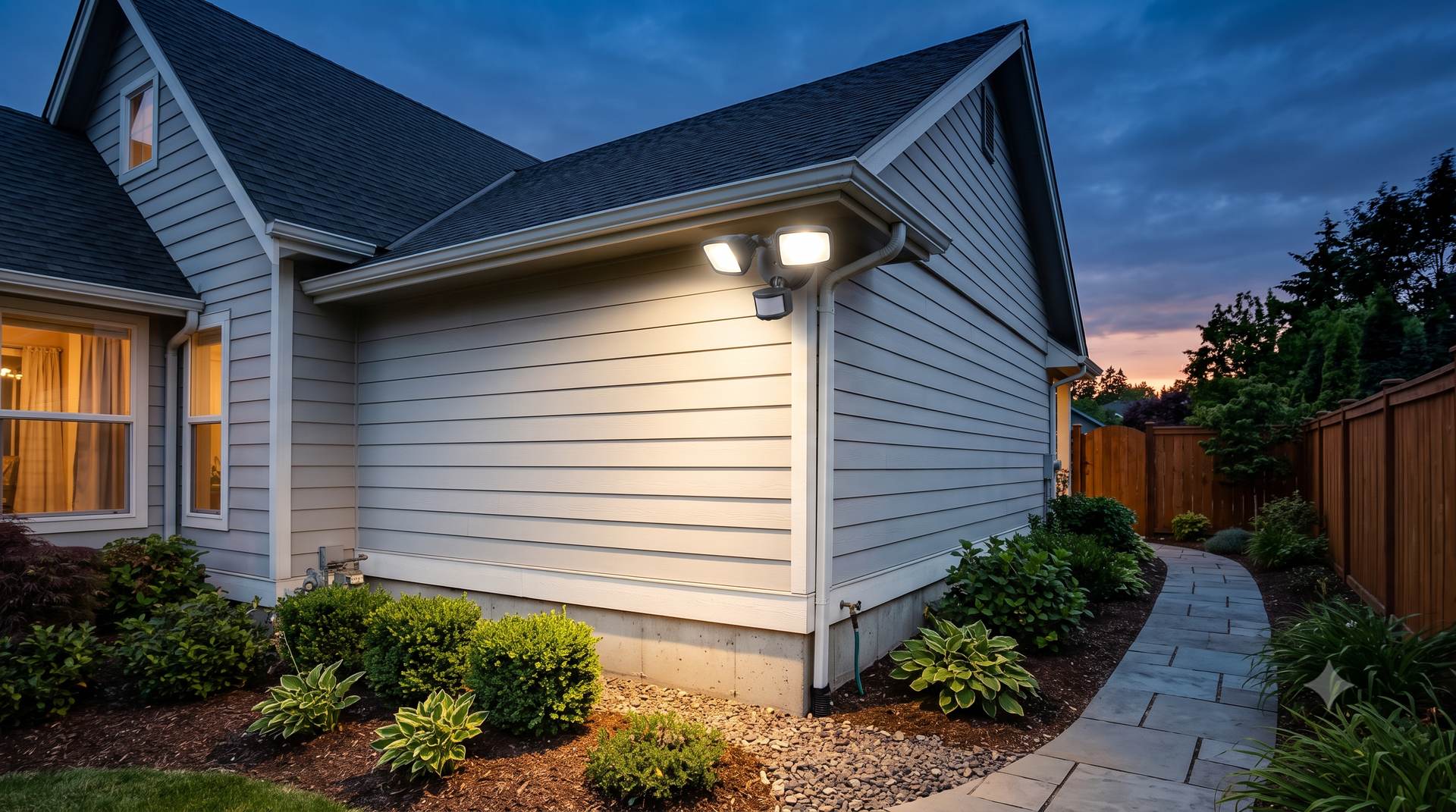
Motion-activated lighting
Motion-activated lights serve two purposes in pest prevention. First, they startle nocturnal animals approaching the home. Second, and more durably, they make the area around the foundation visible, so you can see activity and animals feel exposed. The deterrent effect fades with habituation, but the visibility benefit is permanent.
Placement matters more than brightness. Position lights to illuminate the foundation line, entry doors, garage approaches, trash storage areas, and any other locations where you have seen animal activity. Solar-powered LED units with adjustable sensitivity are widely available for $15 to $40 each and require no wiring.
Best placement
Foundation perimeter (especially near known entry points), trash can areas, garden perimeter, and paths between dense vegetation and the house. Angle the sensor to cover animal-height movement, not vehicle traffic on the street.
Limitations
Lights do not physically prevent access. Animals that have habituated to the light will ignore it. Raccoons, which are abundant in residential areas and comfortable around human activity, habituate particularly quickly.1 Treat lighting as a supplement to physical exclusion, not a replacement.
Dual benefit
Motion lighting also serves the home security layer. Well-lit entry points deter both wildlife and opportunistic human trespass. A single installation serves both purposes.
Motion-activated sprinklers
Motion-activated sprinklers combine a startling water burst with noise, creating a multi-sensory deterrent that is more effective than light alone. Most units use an infrared sensor that detects animal heat and movement within 30 to 100 feet, then trigger a brief, targeted spray. They are humane, chemical-free, and can be used even on protected species.
Effectiveness varies by species and is subject to the same habituation limitation. Deer, rabbits, and cats tend to respond well. Raccoons and opossums, which are more persistent and intelligent, may habituate faster. Relocating the sprinkler every two to three weeks and combining it with other deterrent types extends its useful life.2
Practical notes
Units connect to a standard garden hose and use 2 to 3 cups of water per activation. Set the sensitivity to match your target animal size so it does not trigger on birds or blowing leaves. Night-only mode reduces false activations and water use during the day when you are in the yard.
Disconnect and drain in winter to prevent freeze damage. Most units cost $30 to $60 and are available at hardware stores and garden centers.
Physical barriers and fencing
Physical barriers do not habituate. A fence that prevents deer from reaching the garden works on the hundredth visit the same way it did on the first. University extension programs consistently identify fencing as the most reliable method for excluding larger animals from specific areas.3, 4
The right barrier depends on the animal and the area you are protecting. There is no one-size-fits-all solution, but the principle is consistent: physical exclusion is the most durable form of deterrence.
Garden fencing for deer
A fence at least 7 feet tall is needed to reliably exclude deer. Montana State University Extension confirms this as the most effective single measure for garden protection.2 Deer netting on tall posts is a lower-cost alternative to rigid fencing for garden enclosures.
Garden fencing for rabbits and small animals
Chicken wire or hardware cloth at least 36 to 42 inches high, with the bottom buried or bent outward in an L-shape to prevent burrowing underneath. West Virginia University Extension recommends a 5-inch buried apron of chicken wire bent at a right angle to stop digging animals.4
Crawlspace and deck skirting
Open crawlspaces and raised decks are common entry and nesting sites for raccoons, opossums, skunks, and feral cats. Hardware cloth (1/4-inch mesh) secured around the perimeter and buried 6 to 12 inches below grade prevents access while maintaining ventilation.
Chimney caps and vent covers
Chimney caps prevent raccoons, squirrels, and birds from entering through the flue. Vent covers with hardware cloth screening prevent nesting in dryer vents, bathroom exhaust vents, and attic vents. These are one-time installations with lasting effect.
Working around habituation
Habituation is not a flaw in a specific product. It is a natural behavior in nearly all animals, and it applies to every sensory deterrent: lights, sounds, sprinklers, scent-based repellents, and visual scare devices. The animal learns that the stimulus does not result in actual harm, and it stops responding.1, 2
The practical response is not to find a deterrent that never habituates (none exist for sensory devices), but to manage the timing and combination:
Rotate
Move devices to a different location every two to three weeks. Relocating a motion sprinkler from the garden edge to the trash area to the compost bin on a rotating schedule keeps the stimulus unpredictable.
Layer
Combine different sensory types. A motion light at one approach, a sprinkler at another, and a physical barrier at the highest-value zone. Animals that habituate to one stimulus still respond to a different one.
Prioritize physical exclusion
Use sensory deterrents to protect the perimeter and lower-value areas. Protect high-value zones (gardens, coops, the house itself) with physical barriers that do not depend on animal behavior. Fencing, hardware cloth, and sealed entry points work regardless of habituation.
Approaches with limited evidence
Some widely marketed deterrent products have limited or mixed support from university research. This does not mean they never work in any situation, but the evidence does not support relying on them as a primary defense.
Ultrasonic repellers
Devices that emit high-frequency sound marketed as pest deterrents have mixed research results. Some animals respond initially, but habituation to fixed, predictable patterns occurs quickly. The FTC has taken enforcement action against companies making unsupported claims about these products. If you use one, treat it as a supplemental tool, not a standalone solution.
Static visual scare devices
Plastic owls, rubber snakes, and predator silhouettes may provide a brief startle response. Animals habituate very quickly to anything that does not move, change position, or present an actual threat. Move them frequently if you use them at all.
Essential-oil repellent sprays
Peppermint oil, cinnamon oil, and similar products are marketed as pest deterrents. Evidence for effectiveness is limited and short-lived. They require frequent reapplication and degrade quickly outdoors. Note: some essential oils, particularly peppermint and tea tree, can be toxic to cats and dogs. The ASPCA lists several common essential oils as potentially harmful to pets.5
For renters
You may not be able to install permanent fencing or hardwired lighting, but several deterrent options require no modification to the property. Solar-powered motion lights can be mounted temporarily with adhesive strips or hooks. Motion-activated sprinklers connect to a garden hose and sit on the ground with no installation. Portable garden netting protects balcony or patio container gardens.
For structural deterrents that require permanent installation (chimney caps, vent covers, crawlspace skirting), request the work from your landlord in writing. These are property maintenance items, and they protect the building, not just the tenant.
Common mistakes
Relying on a single deterrent type
A motion light alone will not solve a wildlife problem. Neither will a sprinkler alone. Deterrents work as a system: combine sensory devices with physical barriers and habitat management for lasting results.
Never moving the device
A motion sprinkler left in the same spot for an entire season will habituate every animal in the area. Rotate its position every two to three weeks to maintain the surprise factor.
Skipping the foundation layers
Deterrence is the third layer, not the first. If the building has unsealed entry points and the yard provides food and shelter, no deterrent device will overcome those attractants. Seal first, manage habitat second, then add deterrence.
Expecting deterrents to handle an active infestation
Deterrents discourage animals from approaching. They do not remove animals already living in the structure. If you have wildlife in the attic, crawlspace, or walls, that is a removal issue for a licensed professional, not a deterrent problem.
Related guides
Exclusion & Sealing
The building layer: sealing the openings that let pests inside.
Yard & Habitat Control
The habitat layer: managing food, water, and shelter around your home.
Home Security
Motion lighting serves both pest deterrence and home security.
Small-Scale Agriculture
Predator fencing and protection for coops, hives, and livestock.
Sources
- USDA APHIS Wildlife Services. Review of visual deterrent effectiveness for wildlife management. Referenced via field studies. Accessed July 2026.
- Montana State University Extension. "Master Gardener Spotlight: Oh, DEER, They're in the Garden Again." montana.edu/extension. Accessed July 2026.
- University of Minnesota Extension. "Keeping Animals Out of Your Garden." extension.umn.edu. Accessed July 2026.
- West Virginia University Extension. "Wildlife Pest Fencing for Gardens." extension.wvu.edu. September 2020.
- ASPCA. "Toxic and Non-Toxic Plants" and essential oil pet safety guidance. aspca.org. Accessed July 2026.
- >EPA. "Integrated Pest Management (IPM) Principles." epa.gov/safepestcontrol. Accessed July 2026.<