Shelter · Pests & Wildlife
Termites & Wood-Destroying Insects
How termites and carpenter ants damage structures, what to look for during routine inspections, conditions that attract them, and why professional treatment is the standard approach.
By Dan Whelan, founder of New World Survival
Researched from government agencies, university extension services, and other published sources. See our sources
Termites cause an estimated $5 billion in property damage to U.S. homes each year. Homeowner's insurance typically does not cover this damage because it is classified as a preventable maintenance issue. The average repair cost for a homeowner who discovers termite damage runs into the thousands of dollars, and severe cases involving structural framing can cost far more.1
The most effective defense against termite damage is not treatment after the fact. It is prevention (eliminating the moisture and wood-to-soil contact that attract them) combined with regular inspection (catching activity early before structural damage accumulates). This guide focuses on what homeowners can do and what to look for, then explains when and why professional inspection and treatment are necessary.
This page does not cover chemical treatment methods, pesticide application, or DIY termite control products. The UC Integrated Pest Management Program and university extension services consistently recommend licensed pest control professionals for termite treatment, noting that successful management requires specialized knowledge of building construction and regulated treatment methods.2
Know the difference
Subterranean termites
The most destructive species in the United States. They live in underground colonies and build mud tubes (pencil-width tunnels made of soil and saliva) to travel between the ground and their food source. They require constant moisture, which is why they maintain contact with the soil. A mature colony can contain hundreds of thousands to over a million individuals.
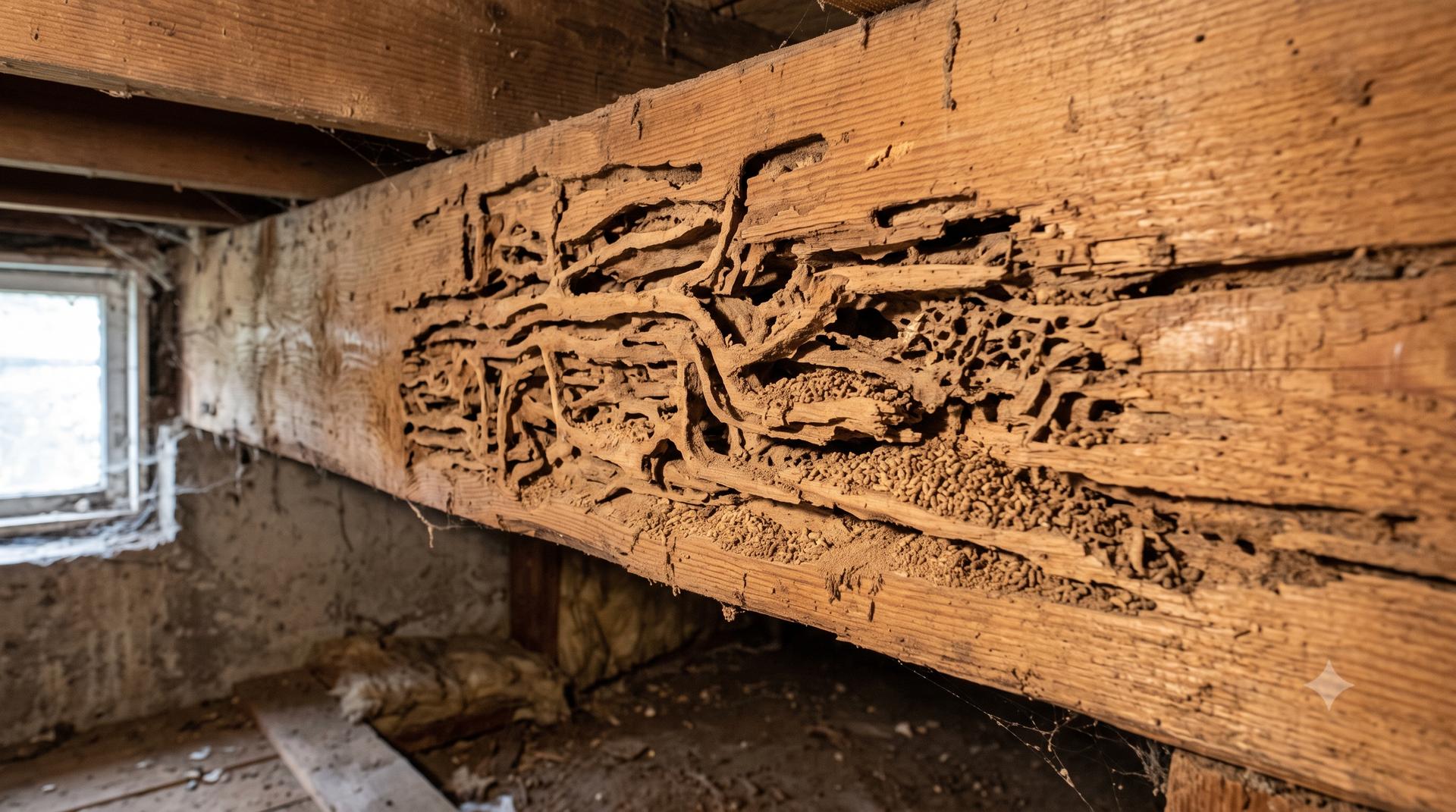
Signs: Mud tubes on foundation walls, pier blocks, or plumbing. Wood that sounds hollow when tapped. A thin, gritty gray-brown film on the surface of damaged wood. Damaged wood with mud-lined galleries. Swarms of winged termites (alates) in spring, often mistaken for flying ants.3
Carpenter ants
Carpenter ants do not eat wood. They excavate it to create smooth, clean tunnels for nesting. They feed on insects, honeydew from aphids, and household food. They are attracted to wood that has been softened by moisture or decay, making water-damaged areas the most common starting point.
Signs: Piles of fine, sawdust-like material (frass) below small, clean openings in wood. Large black or reddish-brown ants (1/4 to 1/2 inch) in the home, particularly near moisture. Rustling or faint crunching sounds in walls. Smooth, sandpaper-finish tunnels in damaged wood (no mud or soil present).4
Other wood-destroying insects
Powder post beetles and old house borers leave small, round exit holes in wood with fine, powdery frass. Carpenter bees bore perfectly round, half-inch holes in untreated or unpainted wood, typically on the underside of eaves, deck rails, and fascia boards. These are less common than termites and carpenter ants but are worth recognizing during inspections. A professional wood-destroying insect report (WDIR) covers all of these species.5
Prevention: what homeowners can do
Moisture is the primary factor. Both subterranean termites and carpenter ants require it. Every prevention step below addresses moisture, wood-to-soil contact, or both. These are the same conditions that extension programs report on wood-destroying insect inspection forms as "conditions conducive to subterranean termites."5
Eliminate wood-to-soil contact
Maintain at least one inch of clearance between soil and wood portions of the building. This includes siding, door frames, deck posts, and stair stringers. Never allow mulch, soil, or landscaping to bury the bottom of wood siding or trim.2
Control moisture around the foundation
Grade soil away from the foundation so water drains outward. Clean and maintain gutters. Extend downspouts at least 3 to 4 feet from the foundation. Fix dripping faucets and irrigation leaks. Ensure crawlspaces have adequate ventilation and are not retaining moisture.
Repair water damage promptly
Wood that has been softened by water damage is the most attractive nesting material for carpenter ants and the most vulnerable to termite feeding. Roof leaks, plumbing leaks, and condensation around HVAC systems create conditions that invite wood-destroying insects.
Store firewood and lumber away from the structure
Keep firewood at least 20 feet from the home and elevated off the ground. Remove old stumps, buried wood scraps, and decaying wood from the yard. These are food sources that draw termites closer to the structure.
Manage mulch near the foundation
Keep mulch no deeper than 2 to 3 inches and maintain a 12- to 18-inch clearance zone between mulch and the foundation. Deep, moist mulch against the siding creates a sheltered path for termites to reach the structure undetected. Consider gravel or crushed stone in the clearance zone instead of organic mulch.
Paint or seal exposed wood
Unfinished, untreated wood is more vulnerable to both termites and carpenter bees. Paint, stain, or seal exterior wood surfaces including eaves, fascia, and deck components. This reduces moisture absorption and makes the wood less attractive as a food source or nesting site.2
Annual inspection: what to look for
NC State Extension recommends annual inspections for termite activity, noting that keeping records of inspection results is important for determining whether damage is new or pre-existing.3 You can do a basic visual inspection yourself. A professional inspection is more thorough and may be required for real estate transactions.
Foundation walls (exterior)
Walk the perimeter and look for mud tubes running up the foundation, especially around pipe penetrations, behind downspouts, and at the sill plate. Mud tubes are typically about pencil-width and follow vertical surfaces.
Crawlspace
Check pier blocks, floor joists, sill plates, and plumbing penetrations. Look for mud tubes, damaged wood, and excessive moisture. Check for wood debris (construction scraps, old form boards) left on the ground, which provides a food source for termites.5
Interior
Tap wood trim around windows, doors, and baseboards with a screwdriver handle. Wood that sounds hollow or feels soft when probed may be damaged. Look for blistering or bubbling paint, which can indicate moisture from termite activity beneath the surface. Check for frass piles (fine sawdust) that indicate carpenter ant or beetle activity.
Spring swarms
Termite swarms typically occur in spring when winged reproductive termites (alates) emerge to start new colonies. Finding discarded wings near windows, doors, or light sources is a common first sign. Swarming termites are often mistaken for flying ants. Termites have straight antennae and equal-length wings; ants have elbowed antennae and wings of different lengths.
When to call a professional
If you find evidence of termite activity (mud tubes, hollow-sounding wood, winged swarms, frass), contact a licensed pest control professional for a thorough inspection and treatment plan. The UC IPM Program notes that homeowners are unlikely to be able to execute subterranean termite control on their own, and that a combination of methods is usually necessary.2
A professional inspection will identify the species, the extent of activity, and the conditions that attracted them. Treatment options vary by species and situation. Many pest control companies offer annual inspection and treatment warranty programs.
Choosing a pest control company
Look for a company licensed by your state's structural pest control regulatory agency. Ask about their inspection process, treatment methods, and warranty terms. Penn State Extension advises homeowners to carefully review the conditions, limitations, and yearly costs associated with warranty renewals.6 Get at least two opinions and estimates before committing to treatment.
Insurance and cost
Most homeowner's insurance policies do not cover termite damage. The full cost of treatment and repair falls on the homeowner. This makes annual inspection and prevention the most cost-effective approach. Catching a problem early, before structural damage accumulates, can save thousands of dollars compared to discovering it during a home sale or renovation.
For renters
Termite prevention and treatment are the landlord's responsibility as a structural maintenance issue. If you notice signs of termite or carpenter ant activity (mud tubes, damaged wood, sawdust piles, winged swarms indoors), document them with photos and notify your landlord in writing immediately. Early reporting protects both you and the property.
What you can do: avoid stacking firewood against the building, report plumbing leaks and water damage promptly, and keep your living space free of excessive moisture.
Related guides
Exclusion & Sealing
Sealing entry points is the first defense against all wood-destroying insects.
Yard & Habitat Control
Foundation clearance zones, mulch management, and firewood storage.
Weather Readiness
Moisture control and weatherproofing that also protects against wood-destroying insects.
Fire & Utility Safety
Structural damage from wood-destroying insects can compromise fire safety.
Sources
- USDA and industry estimates. Termite damage to U.S. structures estimated at $5 billion annually. Homeowner's insurance typically excludes termite damage.
- UC Integrated Pest Management Program. "Subterranean and Other Termites." ipm.ucanr.edu. Accessed July 2026.
- NC State Extension. "Monitoring and Management of Eastern Subterranean Termites." content.ces.ncsu.edu. Accessed July 2026.
- Oregon State Extension. "Carpenter Ants." solvepestproblems.oregonstate.edu. Accessed July 2026.
- NC Department of Agriculture. "Homeowners Guide to Wood Destroying Insect Report." ncagr.gov. Accessed July 2026.
- Penn State Extension. "Eastern Subterranean Termites." extension.psu.edu. Accessed July 2026.