Community Resilience · The Long View
Nobody survives the long term alone
The plan most people picture for the long term is a remote retreat or a stocked compound. Thirty years of disaster research keeps pointing somewhere else: the households that make it through are the connected ones.
FROM THE FIELD
The people who spent years building a retreat and then walked away from it describe the same turn: at some point the inventory stopped being reassuring. The supplies ran in one direction and there was no one near enough to refill them. That recognition appears in account after account from people who went deep into the isolated-preparation model before concluding that the research finding and their own experience were pointing at the same thing.
The Popular Picture
The plan you have probably read about
Search for long-term survival and the same plan comes back. Get out of the city. Buy land somewhere remote. Put in a well, a wood stove, solar panels, a year of stored food. Build a place you can hold on your own, or with a few families you trust, behind a fence you control.
It is a genuinely appealing picture, and parts of it are sound. A household that can produce its own water, heat, and food, far from the crowding that makes many disasters worse, has real advantages. Distance lowers your exposure. Stored supplies buy you time. Skills you have built yourself do not depend on anyone else showing up.
The retreat and the compound are not foolish. For the first weeks or months of a serious disruption, a well-prepared one works close to how it is advertised. The question is not whether it works. The question is how long it works, and what happens after that.
What The Research Found
Every stockpile runs a clock
Here is what the disaster record shows. In July 1995, a heat wave killed hundreds of people in Chicago. Two neighborhoods sat side by side, with nearly identical poverty, nearly identical demographics, the same brutal heat. In one, the death rate was about 33 per 100,000. In the other, it was 3. The difference was not wealth or air conditioning. It was whether people knew their neighbors well enough to knock on a door and check.
The pattern holds far beyond one heat wave. The researcher Daniel Aldrich studied recovery after four major disasters on three continents, expecting to find that money and physical infrastructure decided who rebuilt. What he found instead was that the communities with the strongest social ties recovered fastest and most completely, ahead of wealthier and better-equipped ones. FEMA's own guidance now states plainly that social connectedness plays a crucial role in how well communities prepare for and recover from hazards.
None of this says stop storing water or learning first aid. It says the stockpile has a floor and a ceiling. It buys you a fixed number of days, and when those days run out, what refills the shelves, repairs the pump, sets the broken bone, and teaches the child is other people. A retreat is a bridge. It is not the far shore.
The full research record, and how researchers separate the kinds of connection that matter most, is laid out in Social Capital and Disasters.
From the field · The same recognition that researchers documented in recovery data shows up in personal accounts from people who went furthest into isolated preparation: the inventory was never the bottleneck. What was missing was always a person with a different skill.
The Honest Tradeoff
What isolation cannot refill
Be fair to the retreat, because it earns it. A remote, well-supplied place genuinely buys time, and time is not nothing. In the first phase of most disasters, time is close to the whole game.
But walk the clock forward. The medicine runs out, or the one person who knew how to set a fracture is the person who broke their arm. The pump fails and the replacement part is four hours away on roads nobody is clearing. The children grow old enough to need teaching that a single household cannot supply. Every one of these is a problem stored supplies cannot solve, and that another twenty people, with different skills and different tools, solve almost as a matter of course.
A stockpile is a number that only goes down. A community is the thing that puts what you have used back.
From the field · Accounts of extended isolation, whether from prolonged displacement or years of deliberate self-reliance, add a layer the supply math misses: isolation over time reduces the person. Motivation, judgment, and practical capacity all erode. The gap is not only what you cannot replace from a shelf; it is what you cannot sustain without other people in the room.
What It Asks Of You
The work is smaller than a fence
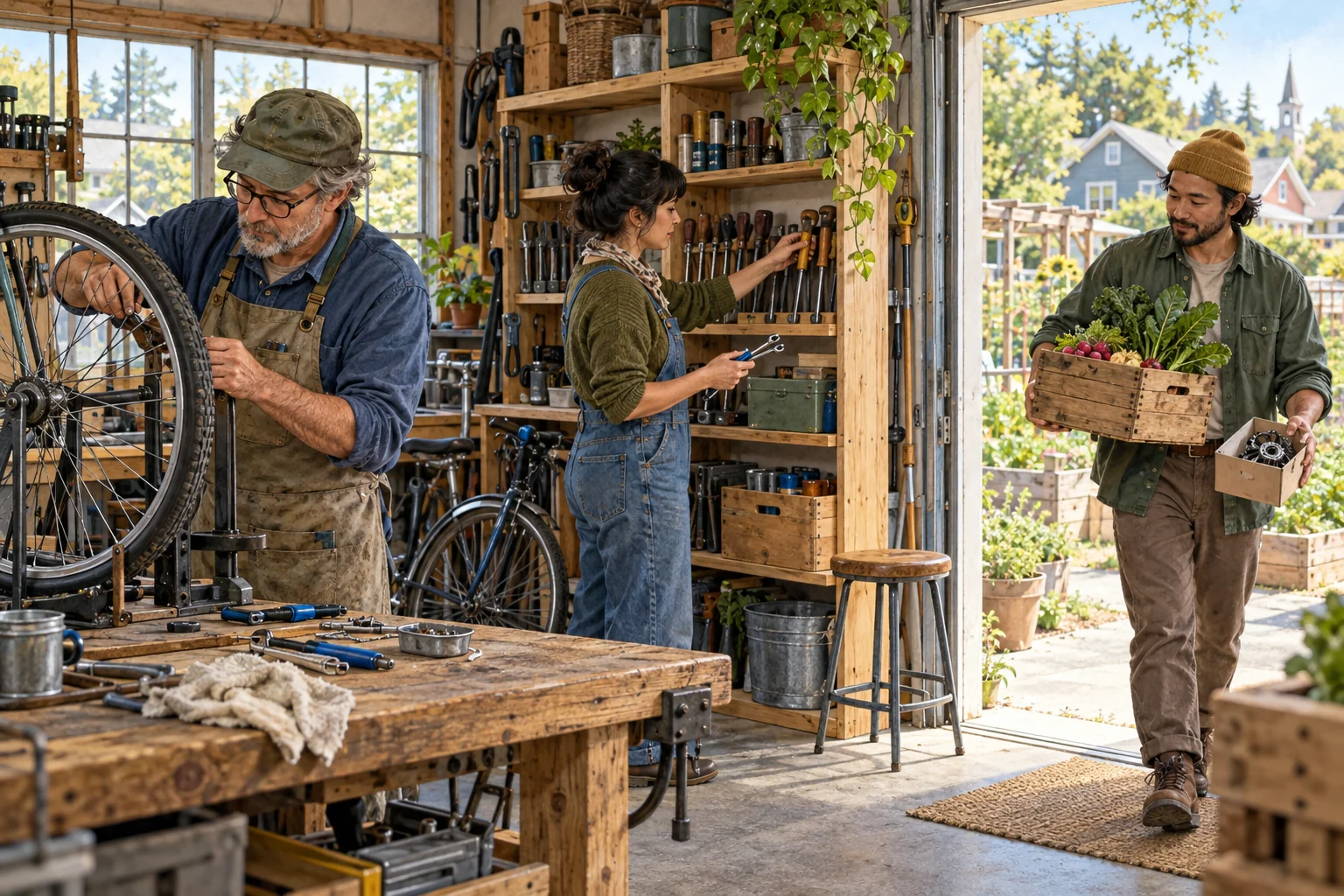
Here is the part that should lower your shoulders. The long view does not ask you to sell your house, move to the mountains, or talk anyone into joining a compound. It asks something smaller, and available today: know the people near you, and be known by them.
Researchers split this into two kinds of connection, and you want both. The first is close ties, the people on your own block or in your own building who could knock on your door within the hour. In the Chicago heat wave, that kind of tie was the single strongest predictor of who lived. The second is reach, the ties that run outside your immediate circle to people with different resources and information. After Hurricane Katrina, households with that wider reach recovered faster, because they knew someone outside the flood who could help.
Neither one needs a catastrophe to be worth building. The same connections that would matter in a disaster are the ones that get a neighbor to jump your car, watch your kids in a pinch, or tell you the water main is out before you fill the kettle. You are building for an ordinary Tuesday. The Tuesday version is simply the one that also holds when the week goes wrong.
Where To Start
Four moves, none of them dramatic
None of these ask you to move, spend much, or become a different kind of person. Each one is a practical capability that happens to be social, and each one compounds.
Know Your Neighbors
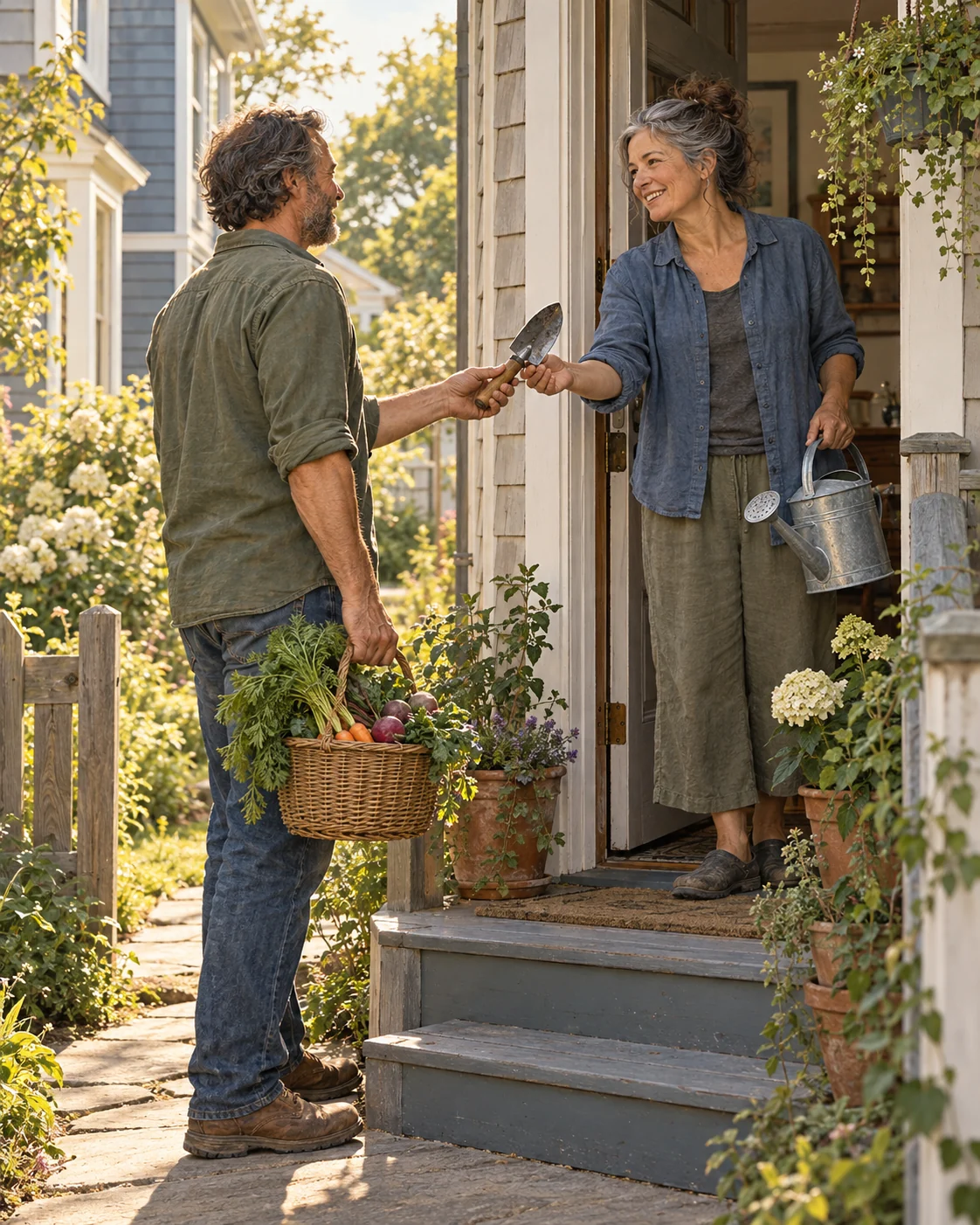
Start with the four doors closest to yours. The close ties that mattered most in the heat wave begin here.
Organize Your Block
Turn a handful of introductions into a contact list, a skills map, and a plan for who checks on whom.
Mutual Aid Networks
Build the wider reach, the ties beyond your block that carry resources and information in a recovery.
Civic On-Ramps
Connect to the programs already doing this work near you, from CERT to your local Red Cross chapter.
The Long View
You are less alone than it feels
If the news has you picturing a fence and a year of freeze-dried food, that instinct is not wrong. It is just aimed a little short. The fence buys days. The people around you are what turn days into years. And unlike the retreat, you do not need money, land, or anyone's permission to start. You need a Saturday and the four doors closest to yours.
The research is not sentimental about this. Connected households do better, in the heat wave and the flood and the ordinary bad week. That is the long view: not a place you retreat to, but a set of people you are known by before you ever need them.
Keep Reading
More in this series
Three companion reads to the long view, each sized to a different starting point.
Preparing Without a Bunker
Right-sized readiness for the disruptions that actually happen, without the doom or the gear.
Prepare When Money Is Tight
The most valuable preparedness is free or nearly free. What to do first when every dollar counts.
When It All Falls Apart
If the fear is loud right now, a calm walk-through of the disruptions that actually happen, and what to do first.
Continue reading
What’s next
Planning
Disaster Response Planning
What happens in the first hours after a disruption, and how neighborhood response begins where household planning ends.
Local Risks
Who Will Check on You?
Building a personal support network before you need one, starting with three specific people and a daily check-in system.
Books
Community Preparedness
Recommended reading on civic institutions, mutual aid, and the community organizing research behind the long view.
Getting Started
When the Lights Go Out
No gear required. A deck of cards and your neighbors can turn a stressful night into something manageable.
Sources
- 1.Klinenberg, Eric. Heat Wave: A Social Autopsy of Disaster in Chicago. Chicago: University of Chicago Press, 2002. (Englewood and Auburn Gresham death-rate comparison.)
- 2.Browning, C.R., Wallace, D., Feinberg, S.L., and Cagney, K.A. "Neighborhood Social Processes, Physical Conditions, and Disaster-Related Mortality: The Case of the 1995 Chicago Heat Wave." American Sociological Review 71(4), 2006. (Independent replication of the neighborhood-level finding.)
- 3.Aldrich, Daniel P. Building Resilience: Social Capital in Post-Disaster Recovery. Chicago: University of Chicago Press, 2012. (Recovery outcomes across Tokyo, Kobe, Tamil Nadu, and New Orleans.)
- 4.Aldrich, D.P. and Meyer, M.A. "Social Capital and Community Resilience." American Behavioral Scientist 59(2), 2015: 254–269.
- 5.Federal Emergency Management Agency. "Engaging Faith-Based and Community Organizations: Planning Considerations for Emergency Managers." 2025. (Recognizes social connectedness as a factor in preparedness and resilience.)
- 6.National Academies of Sciences, Engineering, and Medicine. "Enhancing Community Resilience Through Social Capital and Connectedness." Resilient America Program report prepared for FEMA.