Getting Started
When the lights go out.
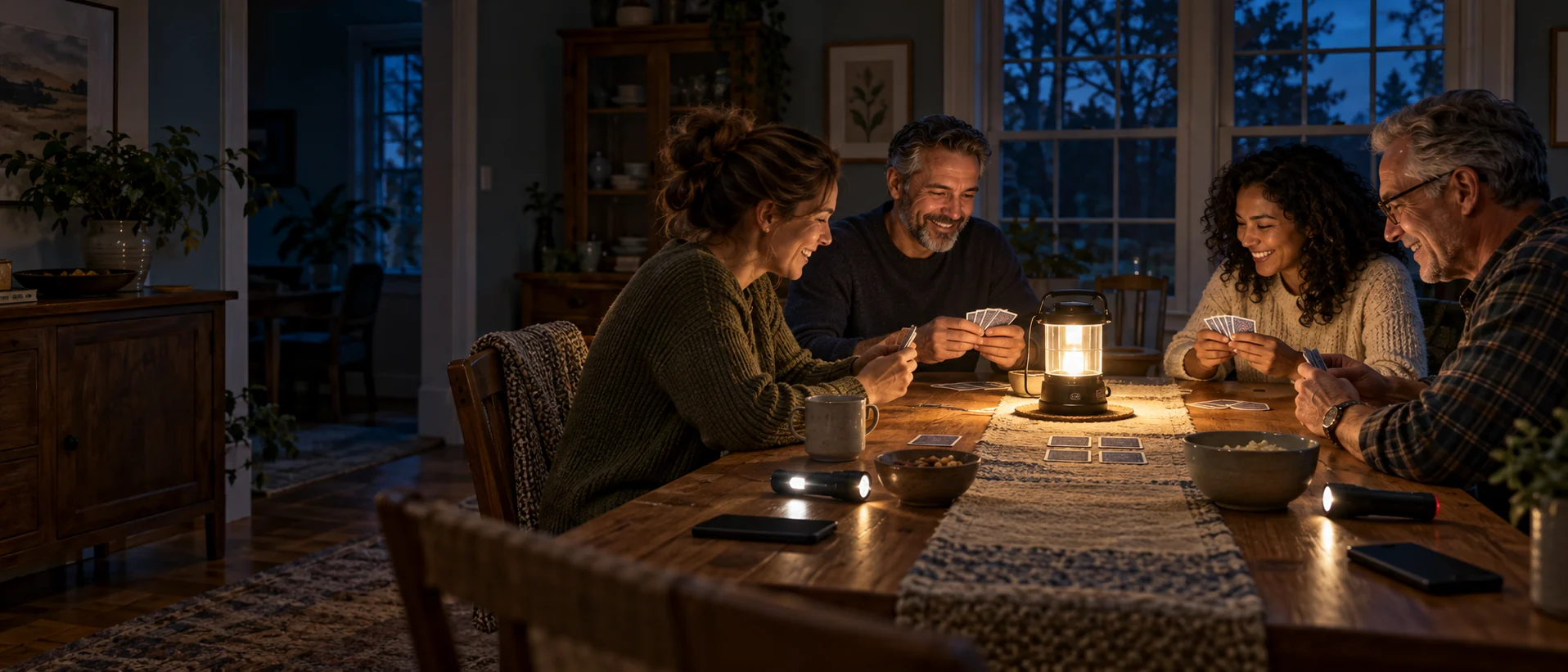
No gear required. No checklist to complete. Just a deck of cards, a few candles, and the people already around you. Some of the best evenings a neighborhood has ever had started with a power outage.
By Dan Whelan, founder of New World Survival
Researched from government agencies, university extension services, and other published sources. See our sources
Conversation Around the table
A fictional conversation exploring real-world questions. Inspired by public discussions; not a transcript or testimonial.
First the lights. Then the cards.
During a short outage on a mild evening, Owen, Claire, Leah, and Ben gather at the table. Their neighbor Marcus has stopped by.

Ben: Are we having dinner in the dark?
Claire: Not in the dark. The battery lantern is here. Let me put it where we can see the table and the way through the room.
Leah: My phone still works. Should I keep checking when the power will come back?
Owen: I reported the outage and checked the utility update. We will check again later. For now, let us keep some charge for messages.
Marcus: I came to see whether you needed anything. I have a working light, but I spent ten minutes finding it. Apparently I prepared the drawer, not myself.
Claire: We have done that. I moved our spare and forgot to tell anyone. After this, everything needs a home we all know about.
Ben: I know where the cards are. Does that count?
Owen: It absolutely counts. First, is everyone comfortable? No one is too hot or cold? We are keeping the fridge closed and having the food that does not need cooking tonight.
Leah: What about Grandma and Granddad?
Claire: They replied a few minutes ago. Their apartment has power, and Ruth has checked in with her neighbor. She asked whether we wanted to come over. We are all right here for now.
Marcus: That is good. If things stop being safe or comfortable, nobody gets a prize for staying put. For tonight, could I join the card game?
Ben: Yes, but Leah has to explain the rules before we start. Not when she is winning.
Leah: That happened once.
Owen: Tomorrow, while we can see what we are doing, let us check where the lights and charging cables live.
Claire: And have Marcus over again when the power is on. We do not need an outage to make room for another chair.
A small next step: Make sure everyone knows where the working lights are; choose a simple shared activity once immediate needs are covered.
Behind this conversation
The situations and dialogue are original. Discussion links provide themes, not verified advice or endorsement.
FROM THE FIELD
Read the accounts people write months or years after a power outage and a pattern emerges that the moment itself obscures: they remember the evening fondly. Not the spoiled food, not the dark hallway, not the dead phone. The candlelight. The conversation. The night nobody looked at a screen. The inconvenience fades from the story. The evening stays.
The first ten minutes
Everyone reaches for their phone.
The power clicks off and the first thing every person in the house does is check their phone. How long will it last? Did the neighbors lose power too? Is there a number to call?
Fair enough. But once you have checked the utility company's outage map and confirmed nobody is in immediate trouble, something interesting happens. The phone goes dark. The TV is already dark. The Wi-Fi router has stopped blinking. And the house is suddenly, unusually quiet.
That quiet can feel uncomfortable for about ten minutes. Then it starts to feel different. You light a candle or dig out a flashlight. Somebody asks, "So... what do we do now?" And right there, in that question, is the beginning of one of the most useful things a household can practice for preparedness.
Not stockpiling. Not building a kit. Just being together without a screen in the room.
What actually happens
People do not fall apart.
There is a stubborn myth that when infrastructure fails, people panic. Movies love this version. The reality, documented in disaster after disaster, is almost exactly the opposite.
On November 9, 1965, a relay failed at a power plant in Ontario and 30 million people across the northeastern United States lost electricity in under five minutes. New York City went dark at 5:27 in the evening, right in the middle of rush hour. 800,000 people were stuck in the subway. Thousands more were stranded in elevators.
What happened next was not chaos. Ordinary people walked into intersections and directed traffic with flashlights. Grand Central Terminal became a giant bedroom for stranded commuters. Macy's opened its cafeteria and fed 5,000 people, then let them sleep in the bedding department. Neighbors who had never spoken ended up eating together by candlelight in diners that stayed open on gas stoves.
The crime rate that night dropped to its lowest recorded level in the city's history. When the lights went out, what came through was not fear. It was friendliness.
Your living room
The best entertainment is already in the room.
You do not need a generator or a battery bank to have a good evening without power. You need a deck of cards. Maybe a board game. Possibly just your voice and a willingness to look a little silly.
Here is what actually works, organized by how much you need to have on hand:
A deck of cards (one dollar, infinite replay)
A single deck of playing cards has kept people entertained for roughly 600 years. Rummy, Spades, Go Fish for younger kids, Poker for the adults after bedtime. The card game is the great equalizer: a ten-year-old can beat a forty-year-old at War, and everyone at the table is paying attention to each other instead of a screen.
If you do not own a deck of cards, fix that this week. It may be the best dollar you spend on preparedness.
Board games (the ones already in the closet)
Cooperative games are especially good here. When the whole table is working together against the game instead of against each other, the mood stays light. Everyone is problem-solving together, laughing at the same setbacks, and celebrating the same wins. That emotional rhythm, everyone riding the same highs and lows, does something to a group that competitive games cannot replicate.
Pull out whatever you have. Scrabble by candlelight has a charm that Scrabble under fluorescent lights somehow lacks.
Nothing at all (parlor games)
Before electricity existed, people entertained themselves every evening with games that required zero equipment. These still work.
- Charades. Act out a word or phrase without speaking. The room will be in stitches within three rounds. Works for every age.
- Twenty Questions. One person thinks of something. Everyone else gets twenty yes-or-no questions to figure it out. Simple, surprisingly addictive, and a genuine exercise in logical thinking.
- Storytelling. Go around the table and each person adds one sentence to a story. The results are unpredictable, often hilarious, and strangely memorable.
- Music. If anybody in the household plays an acoustic instrument, this is its moment. A guitar by candlelight sounds better than it has any right to.
The common thread: every one of these activities requires you to look at the people you are with. That alone makes them fundamentally different from how most of us spend our evenings.
From the field · Adults who grew up in households that lost power describe those evenings as highlights of their childhood. The night the whole family played cards by candlelight. The night they slept together in the living room. The outage was the adventure nobody planned.
When it spills outside
The block party nobody planned.
If the outage lasts more than a few hours, a practical problem shows up: the food in your refrigerator is warming. You can sit there and worry about it, or you can cook it.
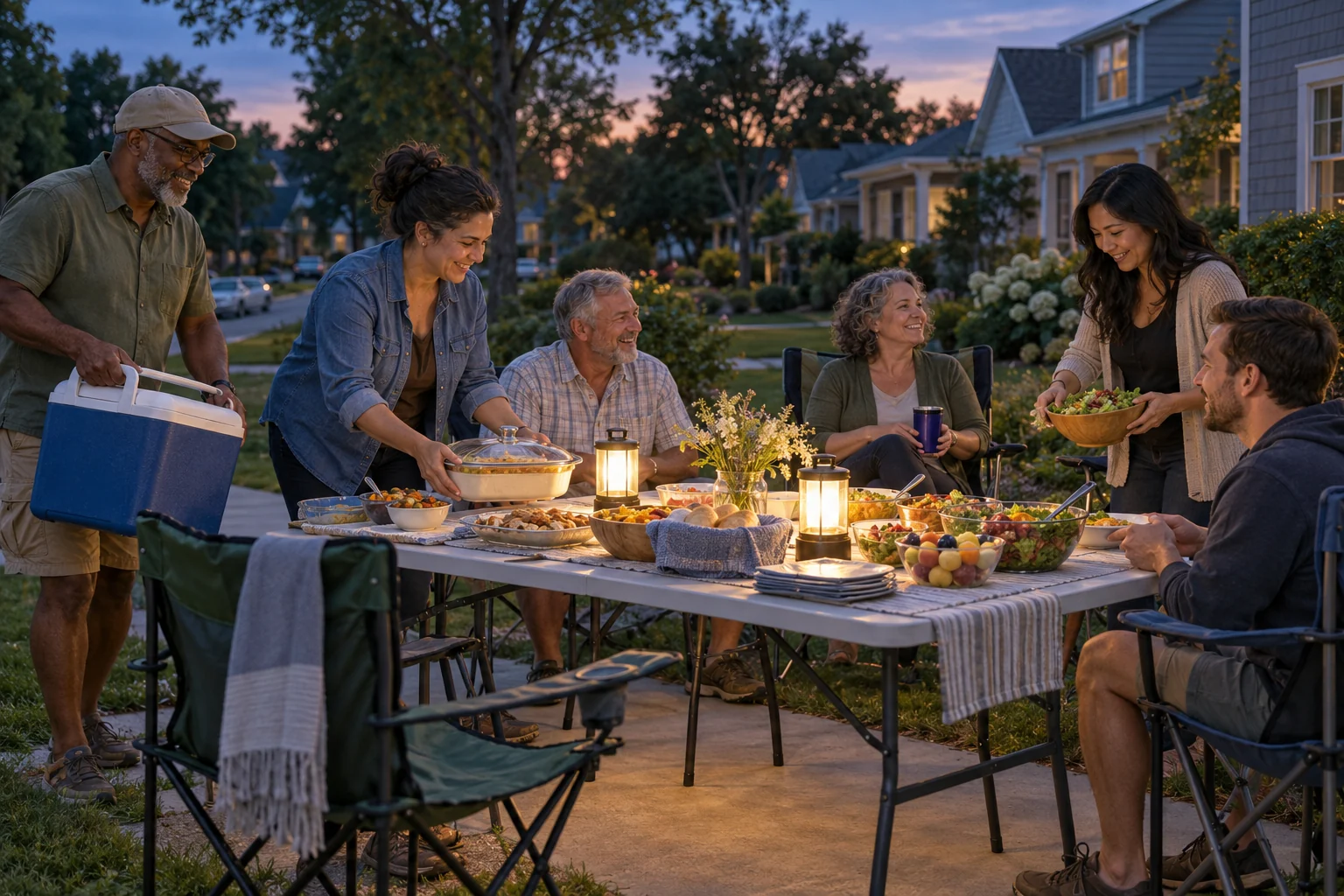
This is how the best block parties start. One household fires up a charcoal grill. A neighbor sees the glow and walks over carrying a bag of thawing chicken. Someone else brings a cooler of drinks that are not going to stay cold anyway. Before long, six households are eating together on the sidewalk.
Nobody sent invitations. Nobody organized a committee. The food was going to spoil, and cooking it together was more fun than cooking it alone. That is the whole formula.
The porch, the stoop, the front yard: these are the places where neighborhood life used to happen every evening before air conditioning and television moved everyone indoors. A power outage temporarily reverses that trend, and the results are almost always warmer than anyone expected.
Why this matters
The people you know are your best safety net.
This is not just a nice evening. It is genuinely useful preparedness, and here is why.
The neighbors you shared a meal with last night are the same neighbors who will check on your elderly parent tomorrow if the outage stretches into a second day. The family you played cards with is the family that will lend you a generator cable or split a load of firewood. The block that has eaten together twice is the block that can organize a chain saw crew after a storm.
Researchers who study disasters have found the same pattern over and over: the neighborhoods that come through hard times best are not the wealthiest or the best-stocked. They are the most connected. The ones where people know each other's names, know who lives alone, know who has a medical condition, and know whose door to knock on when something goes wrong.
From the field · Accounts consistently describe friendships that started during a specific outage and lasted years. The family who brought over food became the family you eat with monthly. The neighbor who shared a generator cable became the person you call first. The relationship outlasted the event by a decade.
A word about longer outages
A short outage can feel like an adventure. A long one is a different matter, especially for people who rely on powered medical equipment, who cannot afford to replace spoiled food, or who live alone without nearby support. The bonding described here does not erase those realities. It helps people weather them together instead of alone. If your household includes someone with medical needs that depend on electricity, that is a reason to plan for backup power, not a reason to skip the card game.
A card game is not a substitute for a generator. But a generator is not a substitute for knowing your neighbors, either. The households that do best in disruptions tend to have both. And one of them costs a dollar and a free evening.
Start tonight
You do not have to wait for a blackout.
The best part of this particular preparedness move is that you can practice it on purpose, and it does not feel like practice. It feels like a good time.
Host a screen-free game night.
Pick a night. Put the phones in a drawer. Light some candles if you want the atmosphere. Pull out the cards or a board game. Invite the family next door if you are feeling bold. You will be surprised how quickly two hours disappear.
Eat outside with your neighbors.
It does not need a reason. Grill some food, set up chairs in the driveway, and tell whoever walks by to grab a plate. The cost is one pack of hot dogs and the willingness to wave somebody over.
Sit on the porch.
This is the lowest-effort version, and it works. Just be visible. People walking by will say hello. Some will stop. Porch culture built neighborhood trust for generations before it was replaced by the living room and the television. Reclaiming it takes one chair and an open evening.
Buy a deck of cards.
Seriously. If you do not have one, get one this week. Put it in the drawer with the flashlight and the candles. When the power goes out, you will know exactly where it is, and the evening will go from stressful to memorable in about fifteen minutes.
Preparedness is not always about supplies. Sometimes it is about the relationships you build before you need them. A deck of cards, a grill, and a front porch can do more for your household's resilience than a hundred dollars of gear collecting dust in a closet.
Continue reading
What’s next
Know Your Neighbors
The Four-Door Introduction
A simple method for meeting the neighbors closest to your door, starting with one knock and zero awkwardness.
Local Risks
Power Outage Preparedness
The practical side: what to do before, during, and after a power outage to keep your household safe and comfortable.
Community
The Long View
Why connected households outlast isolated ones, and what the research says about social ties as a safety net.
Energy
Power Outage Action Plan
When the outage stretches past the first evening: day two and beyond, from food safety to generator sharing.