
Lists Worth Keeping · Curiosities
Eight animals that knocked out the power.
A squirrel stopped the Nasdaq. A monkey blacked out a country. Jellyfish shut down a nuclear reactor. All true, all sourced.
By Dan Whelan, founder of New World Survival
Researched from government agencies, university extension services, and other published sources. See our sources
01 · The story
Seven weeks after Black Monday, the Nasdaq stopped.
On the morning of December 9, 1987, seven weeks after the worst one-day crash in Wall Street history, the Nasdaq stopped. Quotes froze on more than 5,000 stocks. Traders who had spent October watching the market lose a fifth of its value picked up telephones and tried to work the old way, which one executive called somewhat uncomfortable. The outage lasted 82 minutes.
The cause was not a software fault or a cyberattack, a word nobody was using yet. The Nasdaq's computer center sat in Trumbull, Connecticut, and a squirrel had gotten into the local power equipment. The New York Times called it an adventurous squirrel. An AP account adds a detail nobody has been able to improve on: it was carrying a piece of aluminum foil.
Seven years later it happened again. On August 1, 1994, a second Trumbull squirrel chewed through a power line, the backup system failed to pick up the load, and the Nasdaq went dark for 34 minutes. The chairman of the House subcommittee that oversees securities trading said he was deeply concerned about the exchange's stability. Neither squirrel survived.
Those two squirrels are the most famous members of a very large club. Every year, utilities across the country log hundreds of thousands of outages caused by animals, most of them small, most of them short, and almost none of them making the news. The American Public Power Association keeps a running count. It calls it the Squirrel Index.
What follows is eight animals that have shut off the lights somewhere, in roughly ascending order of how much they shut off, and then the one number at the end that puts all eight in perspective.
02 · The list
Eight animals, in rising order of damage.
Every incident below was confirmed by the utility, plant operator, or laboratory involved. Customer counts and durations come from their statements as reported at the time.
-
01
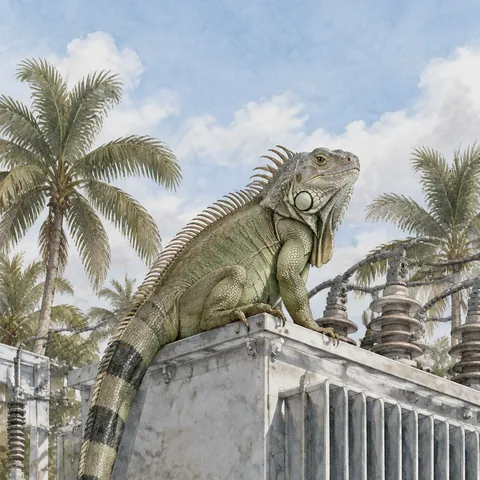
An iguana, Lake Worth Beach, Florida, 2022
On December 7, 2022, a green iguana climbed onto a transformer at the city's 6th Avenue substation and, in the words of the city spokesman, took out the substation. 1,431 customers lost power for about 35 minutes. The city said it had dealt with three iguana incidents that year, down by half from the year before because of new guards on the equipment. An iguana in Key West in 2018 took 69,000 volts, cut power for ten minutes, and walked away.
-
02
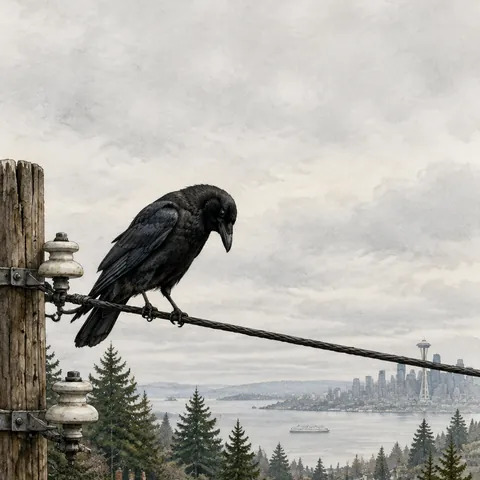
A crow, Seattle, Washington
Birds are the quiet constant. Seattle City Light told KIRO Radio that more than 100 birds cause outages in the city every year, and a single crow put nearly 3,000 Phinney Ridge customers in the dark one morning. In Grand Island, Nebraska, squirrels caused the most outages in 2024, but birds accounted for 39 percent of the total time customers spent without power.
-
03
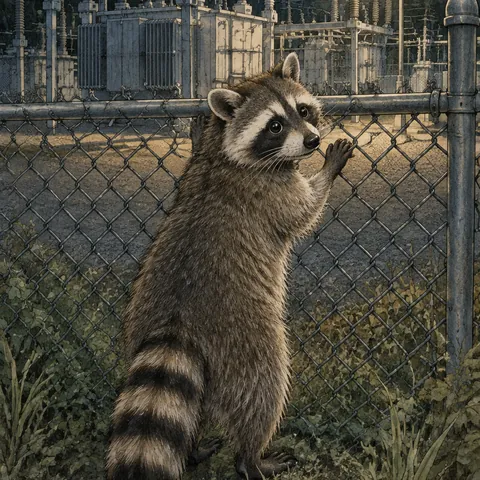
A raccoon, Seattle, Washington, 2016
At 2:45 a.m. on May 11, 2016, a raccoon entered the Canal substation in Ballard and climbed onto an electrical bus, the heavy connecting point for the main feeder lines. The resulting short dropped 38,778 customers across Fremont, Ballard, Queen Anne, and Magnolia. Power was back by about 5 a.m. Neighbors photographed a dazed raccoon at the fence line; the utility later said the one responsible had not survived and the one in the photos was a bystander.
-
04
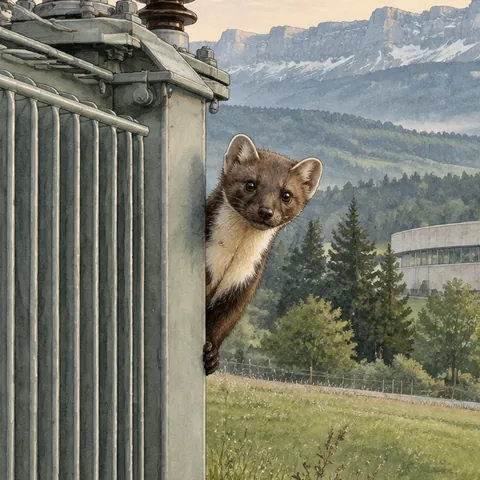
A beech marten, CERN, Switzerland, 2016
At about 5:30 a.m. on April 29, 2016, a beech marten, a weasel-sized European mammal, climbed onto a 66,000-volt transformer at Point 8 of the Large Hadron Collider and shorted one phase to ground. The most complex machine ever built went to standby. CERN's own bulletin recorded that the LHC had been running with stable beams minutes earlier. The marten did not survive, and CERN's weekly summary noted drily that it had not been the best week for the LHC.
-
05
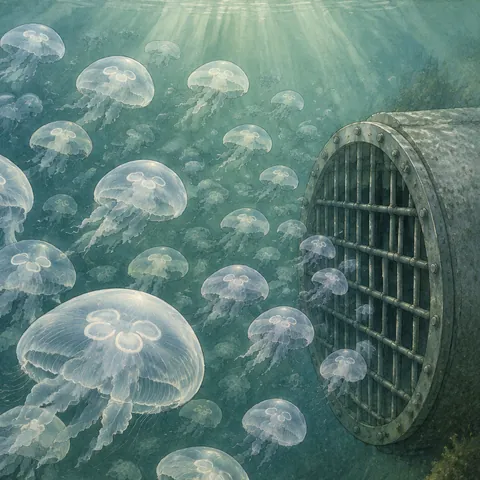
Jellyfish, Oskarshamn, Sweden, 2013
At noon on September 29, 2013, operators manually shut down Oskarshamn Unit 3, a 1,400-megawatt reactor and the largest boiling water reactor in the world, because tons of moon jellyfish had packed the cooling water intake. The water that was blocked never touches the reactor; it condenses steam on the far side of the turbine. The unit was down about three days. The same plant had shut a reactor for jellyfish in 2005, and the Nuclear Regulatory Commission has recorded jellyfish and salp shutdowns at Diablo Canyon in California in 2008 and 2012.
-
06
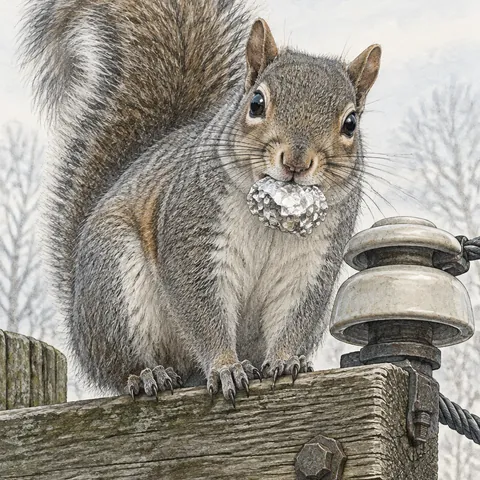
A squirrel, Trumbull, Connecticut, 1987 and 1994
See the story above. Two squirrels, seven years apart, halted the Nasdaq for 82 minutes and then 34 minutes. In the first outage the market fell back on telephones. In the second, the backup power failed to engage. A trading system that handled a fifth of the country's stock volume had, twice, a single point of failure that weighed about a pound.
-
07
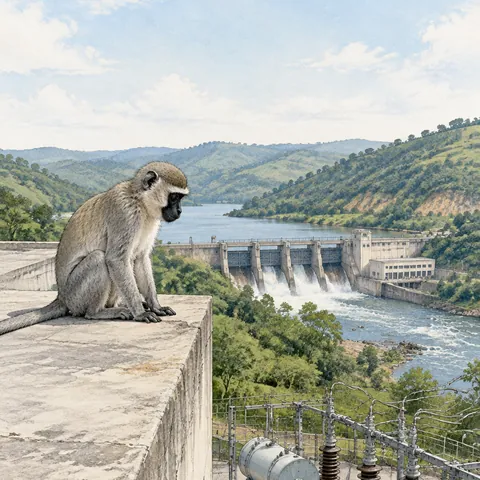
A vervet monkey, Gitaru, Kenya, 2016
At 11:29 a.m. on June 7, 2016, a monkey climbed onto the roof of the Gitaru hydroelectric station, East Africa's largest, and dropped onto a transformer. The transformer tripped, other machines at the plant tripped on overload, the grid lost more than 180 megawatts, and the whole country went dark for more than three hours. KenGen, the state generating company, said the station was protected by electric fencing against marauding wild animals, called it an isolated incident, and reported that the monkey had survived and been handed to the Kenya Wildlife Service.
-
08
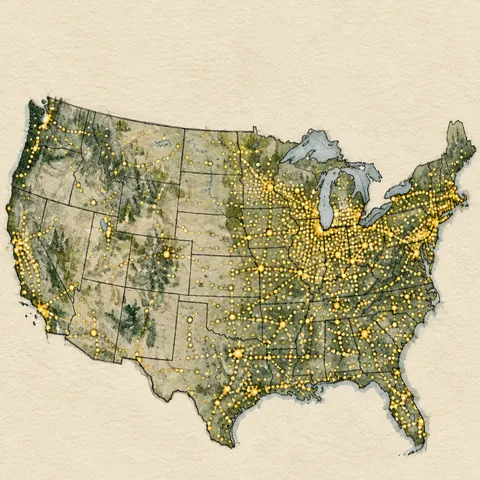
Squirrels, everywhere, every year
In 2018 the American Public Power Association's Squirrel Index recorded 1.63 squirrel outages per 1,000 customers among reporting utilities, which works out to an estimated 244,137 squirrel outages across the country that year. In its 2023 data from more than 300 utilities, squirrels were the third leading cause of sustained outages nationally, behind trees and equipment, and the leading cause in the Midwest at 19.2 percent. They caused 7,196 reported outages that year, more than half of all animal outages. Nobody has ever caused more American blackouts than squirrels.
03 · What it means for you
The outage you will actually have.
Here is the number that puts the eight in perspective. By the industry's own estimate, about 13 million Americans lose power to wildlife in a typical year. Very few of those outages last longer than a couple of hours, and almost none of them are news. The grid's most frequent enemy is not a hostile government or a hurricane. It is a one-pound rodent looking for a place to put an acorn.
That changes what preparedness means for most households. The outage you will actually experience is not the one in the movies. It is the squirrel outage: unannounced, local, two hours long, and over before the refrigerator warms up. Being ready for that one is cheap, and it is the same readiness that gets you through the first two hours of the rare long one.
Three habits cover it. Know where your flashlights are without a phone. Keep the refrigerator closed and do not open it to check; USDA's four-hour rule only holds if the door stays shut. And have one thing to do that does not need electricity, so a two-hour outage is a pause rather than an event. Our power outage action plan and refrigerator during outages guide cover both in detail, and the power outage checklist is the printable version.
And if your lights flicker off on a clear afternoon with no storm in sight, you now know what to suspect first.
Sources
Where the animals come from.
- New York Times, December 10, 1987, as quoted by NPR's history of Wall Street glitches (July 8, 2015). The adventurous squirrel and the 82-minute Nasdaq outage.
- Associated Press roundup of trading glitches (August 2013). The aluminum foil, and the August 1, 1994 outage.
- CNN Money, October 26, 1998. The 1994 squirrel and the 34-minute halt.
- Reuters via Lincoln Daily News, June 8, 2016: Kenya nationwide blackout caused by monkey tripping transformer. KenGen statement: 180 megawatts lost, national blackout.
- NBC News, June 2016: Monkey triggers nationwide blackout in Kenya. KenGen statement text, three-hour duration, the monkey's survival.
- POWER magazine, October 1, 2013: Nuclear plant shut down due to jellyfish. Operator statement on the Oskarshamn Unit 3 manual shutdown and how condenser cooling water works.
- National Geographic, October 1, 2013: Jellyfish invasion shuts down nuclear reactor. The 2005 Oskarshamn shutdown and the Diablo Canyon incidents recorded by the NRC.
- CERN Bulletin, May 2016: the beech marten incident at Point 8. CERN's own account: 66 kV transformer, single-phase fault, stable beams beforehand.
- NPR, April 29, 2016: Weasel shuts down world's most powerful particle collider. CERN spokesman's confirmation and the marten identification.
- KIRO 7, May 11, 2016: Raccoon knocks out power to 39,000 in Seattle. Seattle City Light statements, customer count, the bystander raccoon.
- MyNorthwest / KIRO Radio: a crow causes a Phinney Ridge outage. Seattle City Light on more than 100 bird outages a year.
- WPTV via KSHB, December 2022: Iguana causes large-scale power outage in South Florida city. Lake Worth Beach statements: 1,431 customers, 35 minutes, three incidents in 2022.
- Miami Herald via AOL: Did an iguana just turn out the lights?. The 2018 Key West iguana and Keys Energy Services' iguana-proofing.
- American Public Power Association: Squirrels, a persistent threat to the grid. The Squirrel Index and how it is compiled.
- Portland Press Herald (Washington Post), on the APPA Squirrel Index. 1.6298 squirrel outages per 1,000 customers in 2018 and the 244,137 estimate.
- Nebraska Public Media, November 11, 2025: Squirrels are the leading cause of power outages in the Midwest. APPA 2023 data: third leading cause nationally, 19.2 percent in the Midwest, Grand Island figures including birds at 39 percent of outage time.
- Virginia, Maryland and Delaware Association of Electric Cooperatives: Nature's troublemakers. 7,196 squirrel outages in 2023, more than half of all animal outages.
- The Nature Conservancy, October 29, 2019: Fear the squirrel. Industry estimate of about 13 million Americans losing power to wildlife each year.
All sources accessed 2026-11-09. Where a utility's statement was reported by a news outlet, the outlet is cited and the statement is attributed to the utility in the text.