
POWER OUTAGE · FOOD SAFETY
Keep the cold. Keep the food.
A closed refrigerator keeps food safe for about 4 hours. A full freezer holds for roughly 48. This page covers what to do before, during, and after a power outage so you lose as little food as possible and never have to guess what is safe.
By Dan Whelan, founder of New World Survival
Researched from government agencies, university extension services, and other published sources. See our sources
THE NUMBERS THAT MATTER
How long food stays safe.
These windows come from the USDA Food Safety and Inspection Service and FoodSafety.gov. They assume the door stays closed.
REFRIGERATOR
About 4 hours
An unopened refrigerator holds food below 40 degrees F for approximately 4 hours. After that, perishable food enters the danger zone.
FULL FREEZER
About 48 hours
A full, closed freezer maintains a safe temperature for roughly two days. A half-full freezer holds for about 24 hours.
DISCARD THRESHOLD
40 degrees F, 2 hours
Perishable food held above 40 degrees F for 2 hours or more must be discarded. When ambient temperature exceeds 90 degrees F, the window shrinks to 1 hour.
THE COLD-KEEPING SEQUENCE
-
01
Close the doors
Protect the cold already inside.
-
02
Watch temperature
Use the appliance thermometer instead of guessing.
-
03
Add cold or power
Act before the compartment crosses 40 degrees F.
-
04
Decide item by item
Use time, temperature, ice crystals and the food table.
Every strategy on this page exists to extend those windows or restart the clock. The preparation steps buy the most time for the least effort.
BEFORE THE OUTAGE
Seven things to do while you still have power.
A forecast storm, a planned utility shut-off, or just hurricane season starting. These steps take about 30 minutes and can double the time your food stays safe.
Place appliance thermometers
Put one in the refrigerator and one in the freezer. USDA FSIS recommends them because they answer the only question that counts after an outage: what temperature is the food actually at? Without them, you are guessing, and guessing means throwing out food that might have been safe or keeping food that is not.
Turn both to their coldest settings
A colder starting temperature buys more time before food crosses the 40-degree threshold. The FDA recommends the refrigerator at or below 40 degrees F and the freezer at 0 degrees F or below as normal operating temperatures. Dropping them lower before a storm extends the passive window.
Freeze water bottles and fill empty space
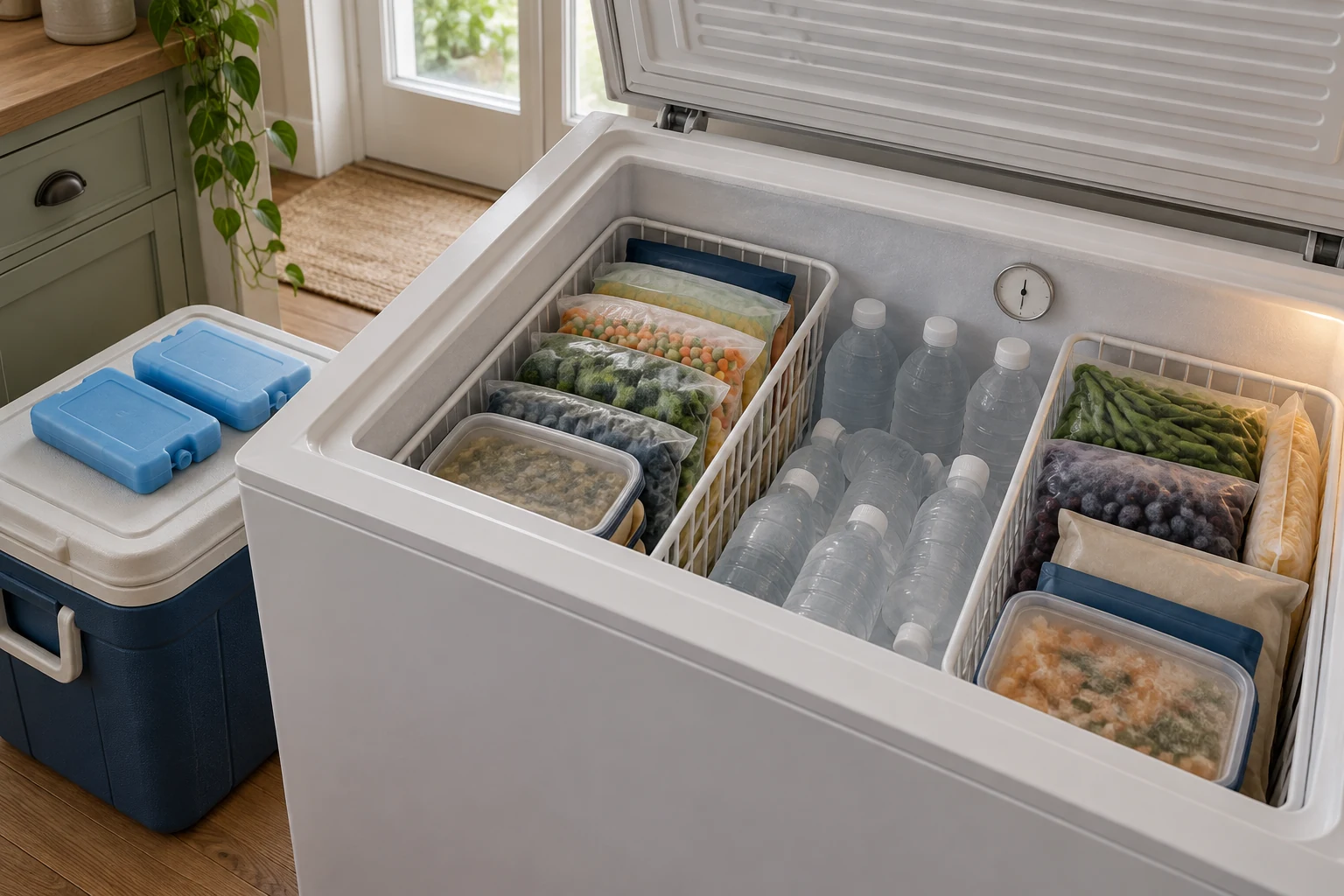
Fill plastic bottles or freezer bags with water and freeze them. Pack them into any empty space in the freezer and add a few to the refrigerator. FoodSafety.gov recommends this for two reasons: the ice extends cold retention, and it becomes drinking water if the water supply is also disrupted. A full freezer holds cold roughly twice as long as a half-full one.
Group freezer items tightly together
Pack frozen items close together so they insulate each other. Each frozen item acts as a cold pack for the items around it, slowing the overall warming rate. This matters most in a freezer that is not completely full even after adding water bottles.
Move eat-first items to the front
Arrange the refrigerator so anything you plan to eat early in the outage is at the front. This means fewer seconds with the door open when you do open it, and less cold air lost per trip.
Prepare a separate cooler
Load a cooler with ice or frozen gel packs and stock it with drinks, condiments, and snacks you will reach for during the outage. This keeps you out of the refrigerator entirely for routine access, which is the single biggest extension of the 4-hour window.
Know where to buy ice and dry ice
Both FSIS and FDA recommend knowing your local ice sources before you need them. Grocery stores and home improvement stores commonly carry block ice and dry ice, but supply disappears fast ahead of a storm. Having two or three sources identified means you are not driving around after the weather arrives.
IF YOU HAVE NO WARNING
Not every outage comes with a forecast. If the power drops without preparation, the two highest-value actions are: stop opening the refrigerator door, and move drinks and snacks to a cooler with whatever ice you have on hand. Those two steps alone protect most of the 4-hour window.
KNOW YOUR NUMBERS
What the refrigerator actually needs.
Three numbers decide every refrigerator backup plan. All three come from a measurement, not from the label on the back.
RUNNING WATTS
100 to 200W typical
What a modern full-size unit draws while the compressor runs. The nameplate reads far higher because it lists the maximum, not the average.
STARTUP SURGE
Several times running watts
A fridge running at 150W can demand 1,000W or more for a second or two at compressor start. Any station or generator has to clear this bar, not just the running load.
DAILY ENERGY
Roughly 1 to 2 kWh/day
The compressor cycles on and off, so the daily total matters more than any hourly figure. This is the number that sizes multi-day plans.
Your refrigerator's real numbers may sit well outside these ranges, especially if it is older or lives in a hot kitchen. The measuring guide shows how to get all three figures from one plug-in meter session. With them in hand, the three checks in the power station guide tell you exactly what equipment qualifies.
DURING THE OUTAGE
Door discipline comes first.
For most outages, the refrigerator needs no power at all. It needs discipline. The cold already inside the box is your first and cheapest resource, and the door is the only way it escapes.
Keep the door closed
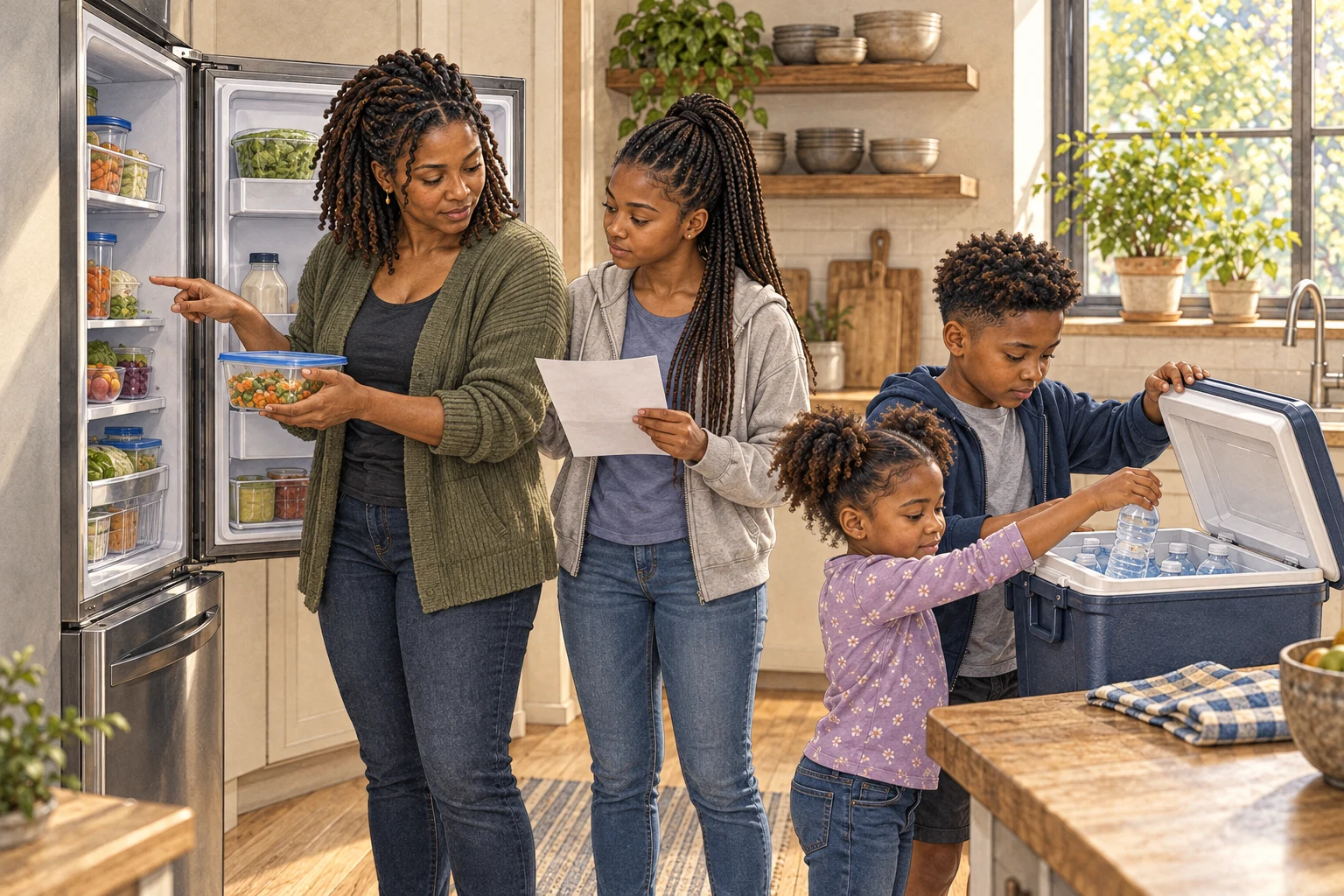
Every opening lets cold air escape and shortens the safe window. Decide what you will eat before opening the door, take it in one trip, and close it. If you placed appliance thermometers inside, read them through the door glass or wait until you are already opening for food rather than opening just to check.
Use the separate cooler for drinks, snacks, and condiments. The fewer reasons you have to open the main refrigerator, the longer its contents stay safe.
The passive windows
USDA FSIS guidance: an unopened refrigerator keeps food safely cold for about 4 hours. A full freezer holds for approximately 48 hours, a half-full one for 24, as long as the door stays closed.
These windows also change the powering math. You do not need to run the refrigerator continuously to keep it safe. You need to keep the inside at 40 degrees F or below, and a cold, closed, full box does most of that work itself. Every powering strategy below builds on that fact.
When ambient temperature matters
A summer outage in a house without air conditioning means the kitchen itself may be above 90 degrees F. In that environment, the USDA discard threshold tightens from 2 hours above 40 degrees F to 1 hour. The refrigerator also warms faster because the temperature difference between inside and outside is larger.
A winter outage works the other way. If the house drops to 50 or 60 degrees, the refrigerator loses heat more slowly because it is not fighting a hot kitchen. Some households with an unheated garage or enclosed porch have a natural cold zone that can extend the window further, though outdoor temperatures below freezing can damage some produce and burst cans.
Apartment and renter considerations
A generator is not an option for most apartment dwellers. Battery stations, coolers with ice, and door discipline carry the entire plan. The preparation steps matter more, not less, when you cannot fall back on a generator.
If you know a long outage is coming and have no backup power, the cooler transition (below) becomes the primary strategy rather than a last resort. Move the highest-value perishables to a cooler with ice early, before the refrigerator warms past the threshold.
WHEN THE WINDOWS CLOSE
Powering the fridge past the passive window.
Two tools carry a refrigerator through a longer outage: a battery station, a generator, or the two working in shifts. The thermometer, not the clock, decides how hard either one has to work.
Battery station
A 1,000Wh station runs a full-size refrigerator averaging 150W for roughly 6 to 7 hours. At 1 to 2 kWh per day of demand, one charge covers part of a day, a 2,000Wh station covers most of one, and anything longer needs a recharge path such as a 200W solar panel or a generator.
Check the surge rating before trusting any station with the job. A unit that stores plenty of energy but cannot start the compressor is no help at all. Overnight is where a station shines: silent, indoor, and carrying the fridge while a generator sits off.
How long will it actually run yours
A refrigerator is rarely the only thing on the list. The calculator runs the same arithmetic against everything else you plan to keep going, and tells you how many hours a specific battery station holds the fridge alone.
Open the Power Needs CalculatorGenerator cycling
A generator does not need to run around the clock. Run it for an hour or two to pull the refrigerator and freezer back down to temperature, then shut it off and let the closed box coast. Let the appliance thermometers set the schedule: restart when the refrigerator approaches 40 degrees F.
Cycling stretches fuel dramatically and buys quiet hours. Start the refrigerator on its own before adding other loads so startup surges never stack. The generator guide covers sizing, fuel, and transfer switches.
For outages lasting more than a day, many households run the generator for a few hours in the morning and a few in the evening, coasting through the night on a battery station or on the thermal mass in a well-packed freezer. The extended outage timeline covers the day-by-day decision framework.
BATTERY RUNTIME
Usable watt-hours ÷ average watts = approximate hours
Runtime capacity and startup-surge capacity are separate checks. A station must pass both.
GENERATOR CYCLING PATTERN
- 1 · COOL
Start the refrigerator by itself and pull it down to temperature.
- 2 · COAST
Shut the generator off and keep the appliance closed.
- 3 · MEASURE
Restart as the refrigerator approaches 40 degrees F.
CARBON MONOXIDE. NON-NEGOTIABLE.
A generator produces carbon monoxide, an odorless gas that kills. CPSC data attributes roughly 85 to 100 deaths per year to portable generator CO poisoning, most during outages. Run the generator outdoors only, at least 20 feet from any door, window, or vent, with the exhaust pointed away from the house.
No refrigerator full of food is worth bending this rule. The full protocol is in Generator and Backup Power Safety.
NO POWER AT ALL
Ice, dry ice, and the cooler transition.
When no power source is available, cold itself becomes the supply run. FSIS and FDA both recommend knowing where to buy block ice and dry ice before you need them, because supply disappears fast ahead of a storm.
Dry ice and block ice
The FSIS benchmark: fifty pounds of dry ice holds an 18-cubic-foot, fully stocked freezer for two days. Block ice does the same slower work in the refrigerator compartment. Grocery stores and home improvement stores commonly carry both.
Handle dry ice with insulated gloves, never bare hands. It releases carbon dioxide as it sublimates, so crack the windows when transporting it and never seal it in an airtight container or an unventilated room.
The cooler transition
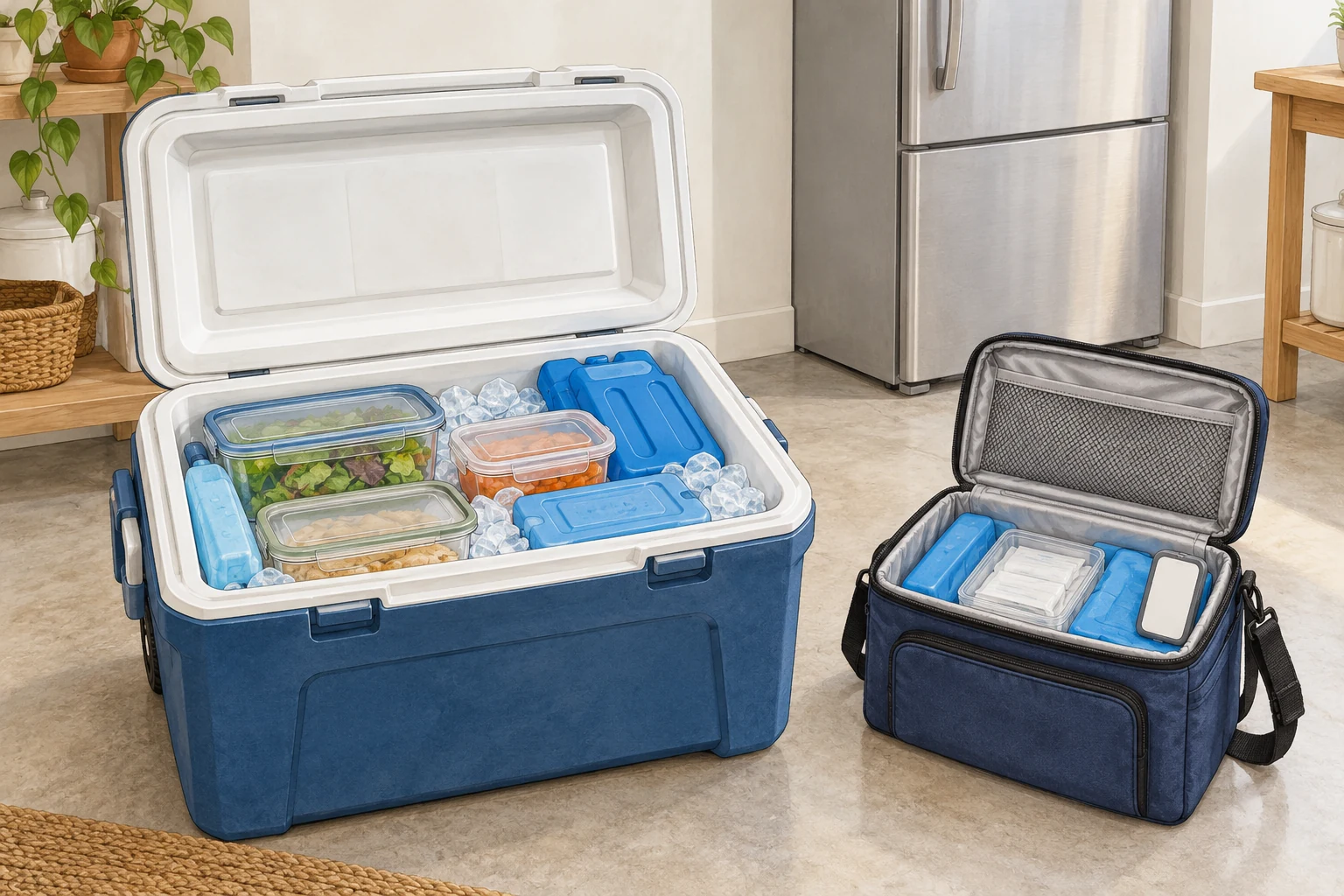
When the refrigerator's window closes and no resupply is coming, move what matters most into a cooler packed with ice or frozen gel packs. USDA guidance is simple: keep the contents at 40 degrees F or below and add ice as it melts.
Prioritize by value and risk: medications that need refrigeration first, then meat and dairy you will cook soon. A cooler kept in the coolest room of the house, opened rarely, outperforms a warming refrigerator.
MEDICATIONS THAT NEED REFRIGERATION
Insulin, some liquid antibiotics, certain eye drops, and other medications require refrigeration. These take priority in any cooler triage because replacing a medication during a disruption is harder than replacing food. Use a dedicated small medication cooler or insulated bag with gel packs, separate from the food cooler, so it stays closed except for doses.
The Refrigerated Medications guide covers the full protocol for keeping temperature-sensitive medications safe during outages.
KEEP OR DISCARD
Food-by-food reference after a power outage.
This table covers refrigerated food that has been above 40 degrees F for more than 2 hours. It is adapted from the FoodSafety.gov and USDA FSIS food safety charts. When in doubt, throw it out.
Refrigerated food
| Food item | Above 40 degrees F for 2+ hours |
|---|---|
| Meat, poultry, and seafood | |
| Raw or cooked meat, poultry, fish, seafood | Discard |
| Thawing meat or poultry | Discard |
| Lunchmeats, hot dogs, bacon, sausage | Discard |
| Meat, tuna, shrimp, chicken, or egg salad | Discard |
| Gravy, stuffing, broth | Discard |
| Pizza with any topping | Discard |
| Casseroles, soups, stews | Discard |
| Cheese | |
| Soft cheeses (Brie, cream cheese, ricotta, mozzarella, cottage) | Discard |
| Hard cheeses (Cheddar, Swiss, Parmesan, provolone) | Keep |
| Processed cheeses | Keep |
| Shredded cheeses | Discard |
| Dairy and eggs | |
| Milk, cream, sour cream, yogurt, eggnog | Discard |
| Butter, margarine | Keep |
| Fresh eggs, hard-cooked eggs, egg dishes | Discard |
| Opened baby formula | Discard |
| Fruits and vegetables | |
| Fresh fruits, uncut (whole apples, oranges, bananas) | Keep |
| Fresh fruits, cut | Discard |
| Fresh vegetables, uncut | Keep |
| Fresh vegetables, cut; cooked vegetables | Discard |
| Pre-washed, packaged greens (bagged salad) | Discard |
| Potato salad | Discard |
| Sauces, spreads, and condiments | |
| Opened mayonnaise, tartar sauce, horseradish | Discard if above 50 degrees F for 8+ hours |
| Opened creamy-based dressings | Discard |
| Opened spaghetti sauce | Discard |
| Peanut butter | Keep |
| Jelly, relish, mustard, ketchup, pickles, olives | Keep |
| Vinegar-based dressings | Keep |
| Soy sauce, barbecue sauce, Worcestershire | Keep |
| Bread, baked goods, and grains | |
| Bread, rolls, muffins, tortillas | Keep |
| Cooked pasta, rice, potatoes | Discard |
| Refrigerator biscuit or cookie dough | Discard |
| Cheesecake; cream-filled pastries | Discard |
| Waffles, pancakes, bagels | Keep |
| Fruit pies | Keep |
Source: FoodSafety.gov / USDA FSIS food safety during power outage charts. The full government chart includes additional items not shown here. When in doubt about any item, discard it.
Frozen food
Frozen food that still contains ice crystals or reads 40 degrees F or below may be safely refrozen, though quality may suffer. The decisions below apply to food that has fully thawed and warmed above 40 degrees F for more than 2 hours.
| Food item | Still has ice crystals | Thawed, above 40 degrees F 2+ hours |
|---|---|---|
| Meat, poultry, seafood | Refreeze | Discard |
| Milk, eggs (out of shell) | Refreeze | Discard |
| Ice cream, frozen yogurt | Discard | Discard |
| Hard cheeses | Refreeze | Refreeze |
| Casseroles, soups, stews | Refreeze | Discard |
| Fruits (packaged) | Refreeze | Refreeze if no mold or off-smell |
| Vegetables (packaged or blanched) | Refreeze | Discard after 6 hours above 40 degrees F |
| Breads, rolls, muffins (no custard) | Refreeze | Refreeze |
| Pies or pastries with custard or cheese filling | Refreeze | Discard |
| Frozen meals, pizza, convenience foods | Refreeze | Discard |
Source: FoodSafety.gov / USDA FSIS. Quality may suffer in refrozen items. The full government chart includes additional categories.
THE HARD RULES
When to let food go.
The powering strategies and table above buy time and settle most decisions. These four principles from USDA FSIS apply to everything the table does not cover.
A THREE-QUESTION CHECK
-
FROZEN FOOD
Ice crystals remain, or the food is 40 degrees F or below?
It may be refrozen or cooked, though quality may suffer.
-
PERISHABLE FOOD
Above 40 degrees F for 2 hours or more?
Discard it. Use 1 hour when ambient temperature exceeds 90 degrees F.
-
STILL UNSURE
No reliable temperature or time record?
Use the item-by-item table above. Never taste food to test it.
The 40 degrees F, 2-hour rule
Discard perishables such as meat, poultry, fish, eggs, and leftovers that have been above 40 degrees F for 2 hours or more, or 1 hour when ambient temperatures exceed 90 degrees F. This is the FSIS line, and it applies item by item.
The refreeze test
Frozen food that still contains ice crystals or reads 40 degrees F or below may be safely refrozen or cooked, though quality can suffer. Fully thawed food that has warmed past the line follows the discard rule above.
Never taste to test
Bacteria that cause foodborne illness do not reliably change how food looks, smells, or tastes. FSIS is blunt on this: when in doubt, throw it out. A ruined meal is cheaper than a sick household in a disruption.
Let the thermometer decide
If an appliance thermometer was in the compartment the whole time, its reading settles most questions in seconds. If not, check each package for ice crystals and temperature and evaluate one item at a time.
The full food-side treatment, including what to eat first and how to stretch what survives, lives in Food During Disruptions and Food Safety. This page keeps the box cold. Those pages cover what comes out of it.
RELATED GUIDES
More from the energy section.
Power Outage Action Plan
The full first-hour and first-day protocol the refrigerator plan fits inside.
Extended Power Outage
The day-by-day timeline for outages lasting days to weeks, including the refrigerator decisions at each stage.
Portable Power Stations
Sizing, surge ratings, and runtime tables for keeping the refrigerator alive on battery.
SOURCES
Where this comes from.
USDA Food Safety and Inspection Service. "Keeping Food Safe During an Emergency." The 4-hour refrigerator window, 48-hour full freezer and 24-hour half-full freezer windows, dry ice benchmark, and the never-taste rule. fsis.usda.gov
USDA FSIS. "A Consumer's Guide to Food Safety: Severe Storms and Hurricanes." Appliance thermometer guidance, the refreeze test, and the 50-pound dry ice figure for an 18-cubic-foot freezer. fsis.usda.gov
USDA FSIS. "Keep Your Food Safe During Emergencies." Pre-outage preparation steps, frozen water bottle recommendation, cooler guidance, and the item-by-item food safety reference. fsis.usda.gov
FDA. "Food and Water Safety During Power Outages and Floods." Door discipline, dry and block ice guidance, the 40 degrees F / 2-hour threshold, and the 1-hour threshold above 90 degrees F. fda.gov
FoodSafety.gov. "Food Safety During Power Outage." The refrigerated food and frozen food discard/keep charts, the 40 degrees F / 2-hour discard rule, frozen water bottles as thermal mass and drinking water. foodsafety.gov
CPSC. Portable generator carbon monoxide fatality data and placement requirements. Cited in full in the Generator and Backup Power Safety guide.