Start here
The first 24 hours.
The emergency you will actually have.
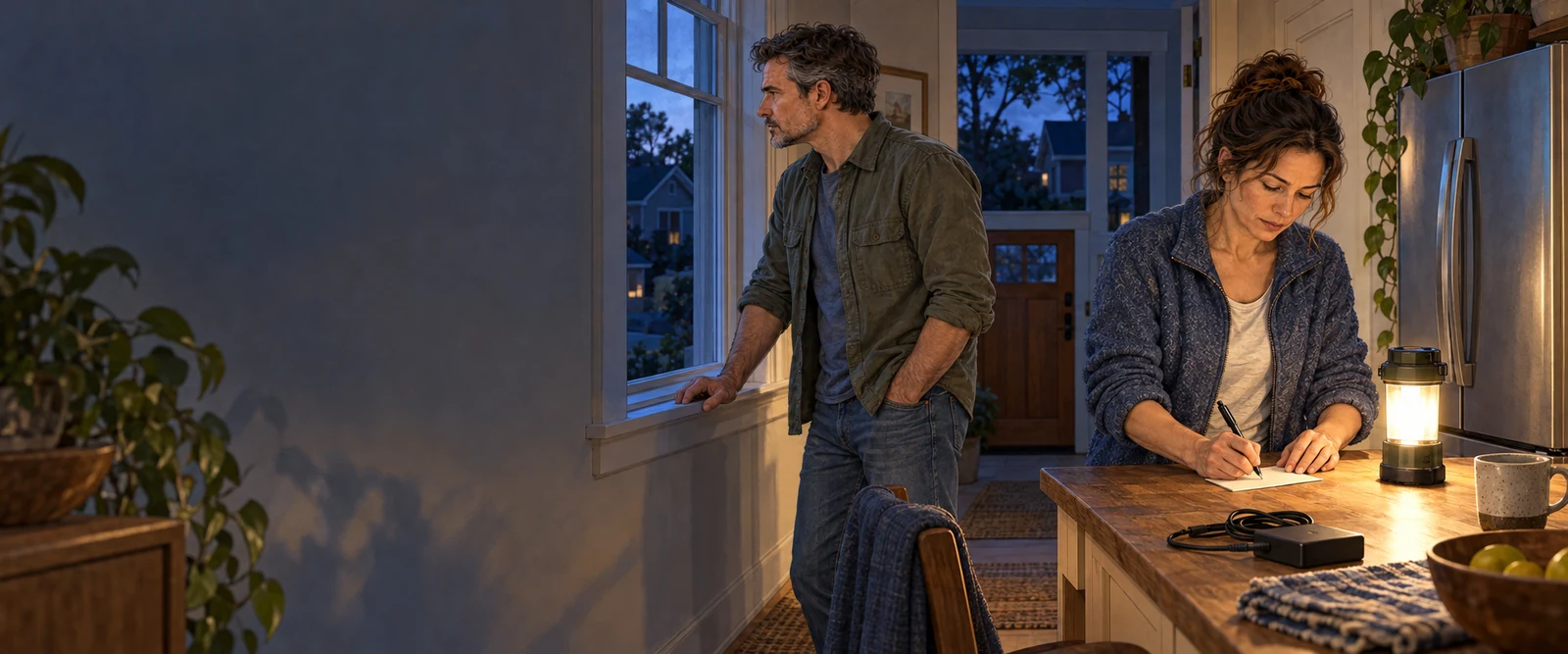
Almost nobody gets the hurricane. Almost everybody gets the evening the lights go out and stay out for a few hours. Nothing on this page asks you to buy anything. It assumes you are standing in a dark house right now.
By Dan Whelan, founder of New World Survival
Researched from government agencies, university extension services, and other published sources. See our sources
FROM THE FIELD
Read the accounts people write after their first real outage and the same hour appears every time: flipping switches that do nothing, opening the refrigerator by reflex, reaching for the remote. The body keeps acting as though the lights are on. It takes most people twenty or thirty minutes to stop reaching and start thinking. This page is the thinking, written down before the moment arrives.
Why this page exists
Most preparedness is written for the worst day. This is written for the likeliest one.
For the great majority of households, the emergency that actually arrives is a power outage. In 2024 the average American electricity customer lost power about one and a half times. Set aside the hurricanes and the ice storms, and those interruptions add up to roughly two hours across an entire year.
That is the honest shape of it. Not a catastrophe. A Tuesday evening with no lights, a refrigerator you are suddenly thinking about, and a house that starts drifting toward too cold or too warm.
It still deserves a plan, not because something worse is coming, but because this is the thing that comes. A short outage rewards a handful of small habits and punishes a few specific mistakes. Both are below.
What the numbers say
Two readings, both true
The U.S. Energy Information Administration tracks how long the average customer goes without power each year. Excluding major storms, that number has held near two hours annually for more than a decade.
Add major events back in and it swings hard with the weather. 2024 came in near eleven hours, the highest in ten years, with roughly eighty percent of it traced to Hurricanes Beryl, Helene, and Milton. Most outages are short. A few are not, and where you live decides which kind you tend to get.
Right now
The first ten minutes, in order.
None of this requires equipment you had to buy in advance. Work down the list.
01
Write down the time
Text it to yourself, put it on the refrigerator door, or say it out loud to someone. Almost every decision below depends on how long this has been going on, and elapsed time is exactly what memory gets wrong once you are tired and moving around in the dark.
02
Check whether it is only you
Look at a neighbor's windows or the streetlights. If their power is on and yours is not, check your main breaker before calling anyone. A tripped main looks exactly like a neighborhood outage from inside the house.
03
Report it
Utilities dispatch crews based on reported outages, and households routinely assume a neighbor called when nobody has. If your phone has no service at all, treat that as information rather than a nuisance. It usually means the event is larger than your street, and a battery radio has just become your best source instead of your backup one.
04
Close the refrigerator and freezer
The clock starts now, and every door opening runs it faster. Decide what you need before you open it, then take it all in one trip.
05
Find light before dark
Your phone works for the next few minutes. Use it to locate real light while you can still see. Then leave one lamp switched on so you know the moment power returns, including at three in the morning.
06
Unplug what you care about
Computers, televisions, and anything with a circuit board can take a hit from the surge when service is restored. A surge protector helps. Unplugged helps more.
Before anything else
Some households do not get the ordinary version.
Everything else on this page assumes a typical house on a typical evening. If any of the following describes yours, the order changes and backup power stops being a comfort question.
Powered medical equipment
An oxygen concentrator, a CPAP, a feeding pump. This outranks the refrigerator, the lights, and everything else here. Many utilities keep a medical priority list for restoration and outage notification. Ask about enrolling on a quiet weekday, not tonight.
Refrigerated medication
Insulin and several other drugs have their own storage rules, and they are not the food rules further down this page. Check the label or call the pharmacy rather than reasoning by analogy.
A private well
No power means no pump, which means no running water and no working toilet, starting immediately rather than after four hours. Fill containers early if you have warning.
A sump pump
If the basement stays dry because of it, an outage during heavy rain becomes a water problem before it is a power problem.
Anyone who handles temperature poorly
Infants, older adults, anyone ill or recovering. Their margin in a cold or hot house is much shorter than yours, and it closes quietly.
Work this out beforehand
There is no good version of solving a medical power problem by flashlight. If one of these applies, the answer belongs in a plan, not in the moment.
The part that causes harm
Short outages rarely hurt anyone. What people bring indoors does.
Carbon monoxide is colorless, odorless, and fast. The Consumer Product Safety Commission estimates that portable generators alone are associated with roughly 85 to 100 deaths a year in the United States. A single portable generator can produce as much carbon monoxide as hundreds of cars.
The rules are short, and there are no exceptions to them.
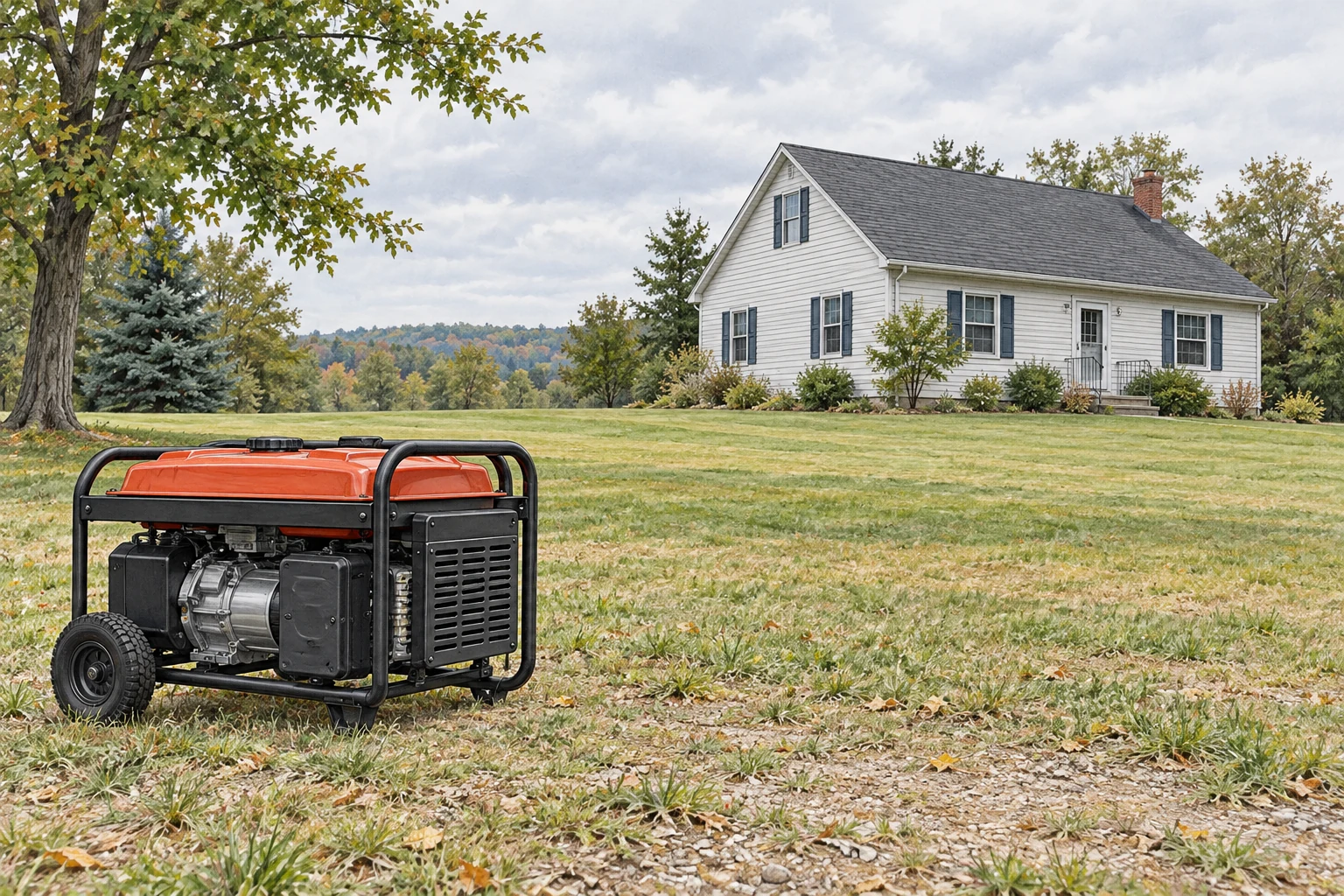
Generators run outdoors only
At least 20 feet from the house, with the exhaust pointed away from doors, windows, and vents. Never in a garage, basement, crawlspace, shed, or carport, and never on a porch. Opening a door or a window does not make an enclosed space safe.
Nothing that burns comes inside
No charcoal grill, no camp stove, no outdoor propane heater, not for heat and not for cooking. Use only equipment labeled for indoor use.
Skip the candles
A flashlight or a battery lantern does the same job without the second emergency. Candle fires cluster in exactly these hours.
If an alarm sounds, go outside first
Battery-powered carbon monoxide alarms belong on every level of the house and outside sleeping areas. When one sounds, get everyone out, then call 911. Do not investigate first.
Food safety
The refrigerator and the freezer, by the clock.
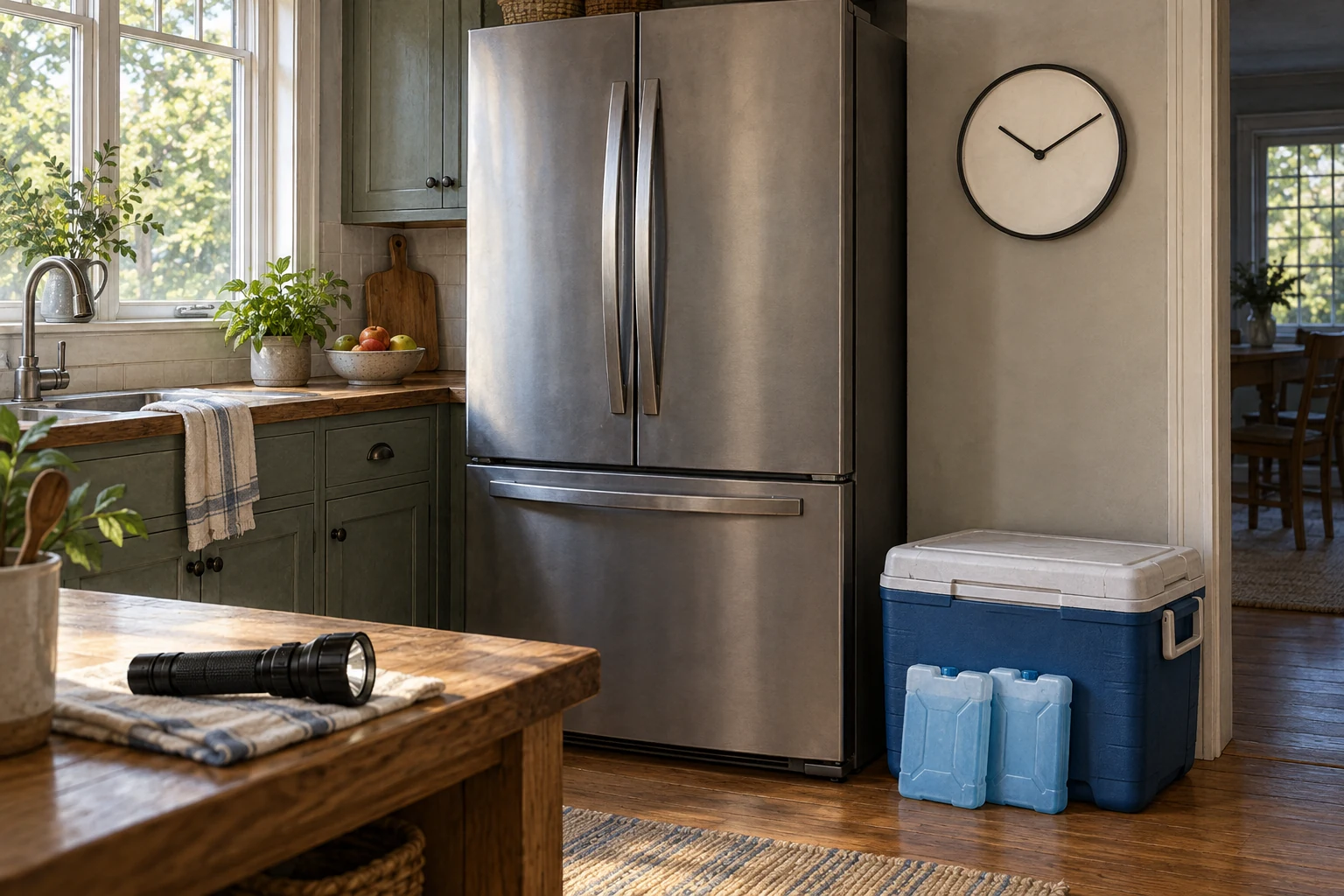
Federal guidance is specific here, and all of it assumes the doors stay closed.
4
Hours
Refrigerator
48
Hours
Full freezer
24
Hours
Half-full freezer
A full freezer holds twice as long as a half-full one because the frozen food is doing the work. If you know weather is coming, fill the empty space with jugs of water and freeze them. They buy time now and become drinking water later.
After four hours without power, discard refrigerated perishables: meat, poultry, fish, eggs, milk, soft cheeses, cut fruit and vegetables, leftovers, and deli items. High-acid items such as mustard, ketchup, jams, jellies, and vinegar dressings are fine.
Frozen food can be refrozen if it still contains ice crystals or is at 40°F or below. Texture may suffer. Safety does not. Discard anything perishable that has sat at room temperature for two hours, or one hour if the room is above 90°F.
Never taste food to decide whether it is safe, and remember that reheating contaminated food does not make it safe. If you have a cooler and ice, move refrigerated perishables into it at the four-hour mark and keep it at 40°F or below. An appliance thermometer in each compartment turns all of this from guesswork into a reading.
From the field · The most common first-day mistake in outage accounts is the one this section warns against: opening the refrigerator to check. Accounts describe the same quiet negotiation between knowing the door should stay closed and the pull of wanting to see.
Temperature
A cold house and a hot house are opposite problems.
The instinct that helps in one will hurt you in the other.
When it is cold
- Pick one interior room with few windows and move everyone into it. Bodies heat a small room well and a large one poorly. Hang blankets over the doorway and across windows.
- Dress in layers, starting with something that moves moisture away from the skin. Hats and wool socks do more than another sweater.
- Let faucets drip slowly and open the cabinet doors under sinks so warmer air reaches the pipes. Know where the main water shutoff valve is before you need it.
- One caution on the small-room approach: it works because you are trapping body heat, not because you are adding a heat source. Nothing that burns fuel belongs in a room you have just closed off.
When it is hot
- Close blinds and curtains on the sunny side of the house, especially south and west facing windows.
- Move downstairs. Heat rises, and a basement or ground floor can run considerably cooler than an upstairs bedroom.
- Put cold wet cloths on the wrists and the back of the neck. Drink steadily whether or not you feel thirsty, and replace electrolytes if you are sweating heavily. Skip physical work during the hottest part of the afternoon.
- Know the line between heat exhaustion and heat stroke. Confusion, skin that has stopped sweating, vomiting, or a very high body temperature is a medical emergency. Call 911.
From the field · In account after account, the car becomes the first answer. Warmth, air conditioning, a phone charge, a radio. During the 2021 Texas freeze, roughly a quarter of households used their car for heat before anything else.
The short list
Five things people forget every time.
The garage door
Find the manual release cord and pull it once so you know how it works. A car shut inside is a small problem that becomes a large one.
Fuel
Gas pumps need electricity. Keeping the tank above half is the cheapest preparation available to anyone.
Water
A gallon per person per day is the working figure. Municipal water usually keeps flowing. A well does not.
Your phone
Lower the brightness and use airplane mode when you are not actively using it. A phone you keep checking drains far faster than one you leave alone.
Cash
Card readers need power too. A small amount in the house covers a gas station or a grocery run on a generator.
From the field · Accounts describe the same first ten minutes: the flashlight in one drawer, the batteries in another, the charger upstairs. The dark scavenger hunt is the reason preparation guides keep saying to put everything in one place.
The part nobody plans for
Look down the street.
In account after account of long outages, the detail people remember is not the equipment. It is that they finally met their neighbors.
An outage is one of the few events that puts everyone on a street into the same situation at the same moment. Knocking on a door to ask whether someone has heat, or a way to charge a phone, or anything in the freezer worth saving, costs nothing and gets remembered for years. If someone nearby is elderly, lives alone, or depends on powered equipment, that knock may matter more than anything else on this page.
It is also the quiet argument for getting ready at all. A household that is steady has something to offer. A household that is scrambling does not.
If it lasts longer than a day
Past 24 hours, the problem changes shape.
Day two is a different set of decisions: the freezer, fuel while stations still have power, hygiene, and whether staying home is still the right call. These guides pick up where this page ends.
Day two and three
The household protocol once an outage stops being a short one, with a printable copy for the binder.
When the power stays off
A day-by-day map of a two-week outage: water, hygiene, fuel, air quality, and morale.
Food through an outage
What to save, what to cook first, and what has to go, in more detail than this page allows.
The energy section
Lighting, batteries, generators, heating and cooling without the grid. The full cluster.
Read these first
Four ideas that save money and effort.
Most people waste their first hundred dollars on the wrong things. A few minutes of reading here keeps you from the common mistakes before you spend anything.
How to prepare without wasting money
Fewer, better things. What to skip, and why a closet full of gear is not a plan.
How to prioritize
Water before food. Health and money before gear. A simple order that keeps you grounded.
Store what you use
The rotation habit that builds a supply at no extra cost and nothing goes to waste.
Getting home when you are away
What lives in the car and the day bag for the times a normal day does not go to plan.
When you are ready for what is next
Handled a day? Three days is one weekend of work.
This page assumed you had nothing ready. The next one fixes that. Water, food, light, medicine, and a household plan, built from what you mostly already own.
Continue to the first 72 hoursContinue reading
Go deeper
Energy
Day Two and Beyond
The 24 hours are over and the power is still out. Freezer decisions, fuel timing, and when to leave.
Energy
Generator Guide
Portable vs. standby, sizing, fuel, and the safety rules that keep CO out of the house.
Case Study
California PSPS 2019
When the utility turned off the power on purpose. What 3 million people learned about planned outages.
Water
Well Water Preparedness
No power means no pump. The connection between electricity and running water that rural households need to solve first.